"How long will it take me to learn to surf?" is the single most asked question from new surfers. The honest answer disappoints most people the first time they hear it.
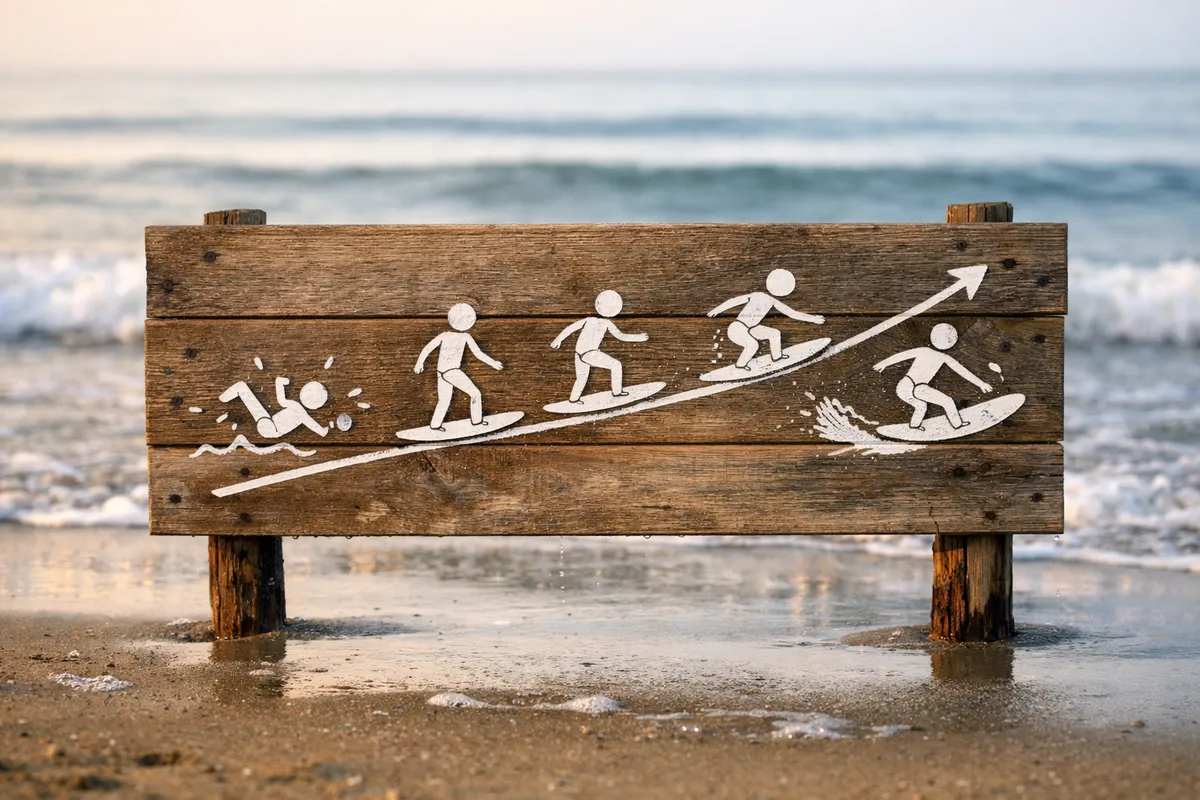
There's no "learned" moment. Surfing is a spectrum with no end. But there are clear milestones, and you can predict most of them with reasonable accuracy based on how often you're in the water.
The short version
- First session (1 hour): stand briefly on broken waves, ride whitewater a few meters
- 3–5 sessions: consistently stand up and ride to the beach
- 1 month / 8–12 sessions: comfortable on whitewater, starting to catch broken waves on your own
- 3 months / 30 sessions: catching unbroken waves at beginner spots, starting to angle and pick direction
- 6 months / 60 sessions: "you can surf" by most people's definition — paddle out, pick waves, ride them down the line
- 1 year / 100+ sessions: confidence at new spots, progressing on smaller boards, handling slightly bigger conditions
- 2–3 years: actually good. Reading waves, making turns, handling most beach breaks comfortably
- 5+ years: lifetime surfer. You never stop learning but nothing is a hard barrier anymore
Those estimates assume 2+ sessions per week, consistent conditions, and at least one or two lessons in the first month. Less frequent practice stretches every stage proportionally.
Session count matters more than time
The single biggest variable in how fast you progress is how often you get in the water. Not how many years you've been surfing, not where, not your age — how many sessions per week.
Someone who surfs 4 times a week for 3 months (48 sessions) will be ahead of someone who surfs once a week for a year (52 sessions) at the same skill level, even though they've put in roughly the same number of sessions. Why? Because dense practice compounds. Muscle memory doesn't reset as much between sessions, you build conditioning faster, and you're in a learning mindset more continuously.
If you can surf 2–3 times a week, you'll hit the "you can surf" milestone in about 6 months. If you can only surf once a week, double everything. If you can only surf once a month, the timeline stretches to 3–4 years and plateaus are very likely — you'll spend each session relearning what you forgot since last time.
What you'll actually be able to do at each stage
Session 1 (first ever)
Goal: feel the wave push the board. Maybe stand briefly. Most people fall more than they ride, and that's fine. A good first lesson will have you standing on at least 2–3 waves before the end.
Sessions 2–5 (first week or two)
Goal: consistent pop-ups on whitewater. You're still riding broken waves, still in waist-to-chest-deep water, still falling a lot. Paddling is starting to feel like you belong on the board.
Sessions 6–15 (first month)
Goal: ride whitewater without thinking about the pop-up. The pop-up should feel automatic now — you're paying attention to where the board is going, not how to get up. You start attempting your first unbroken waves and mostly miss them.
Sessions 16–30 (months 1–3)
Goal: catch your first unbroken wave. This is the breakthrough moment most beginners are chasing — paddling into a green wave on your own, feeling it pick you up, standing, and riding down the face. It usually happens somewhere between session 15 and 30. Celebrate it. Most people surf their whole lives because of that feeling.
Sessions 30–60 (months 3–6)
Goal: pick waves and ride them with direction. You're catching unbroken waves more than half the time you try. You're starting to angle the board so you slide along the wave rather than straight down it. You're still on a soft-top or a funboard but you're starting to think about switching to a smaller hard board.
Sessions 60–100 (months 6–12)
Goal: surf at new spots without help. This is where you cross from "beginner" to "intermediate" in most people's eyes. You can show up at a new beach, read the waves, paddle out, and get some decent rides. You still have a long way to go on technique, but you can surf on your own.
Things that slow people down
- Wrong board. Switching to a shortboard too early is the most common mistake. Shortboards are harder to catch waves on. You'll regress for months.
- Wrong spot. A spot that's over your head makes every session a failure. Stay at beginner spots until beginner spots feel small.
- Inconsistent sessions. Once a month is not enough. Your body forgets between sessions. Go more often or accept slower progress.
- No video feedback. Many intermediate plateaus come from bad habits you can't see yourself doing. Get someone to film you occasionally — or better, book a lesson and ask for video.
- Ego paddling. Trying to compete with faster surfers when you're not ready. You'll get frustrated and get nothing done.
Things that speed people up
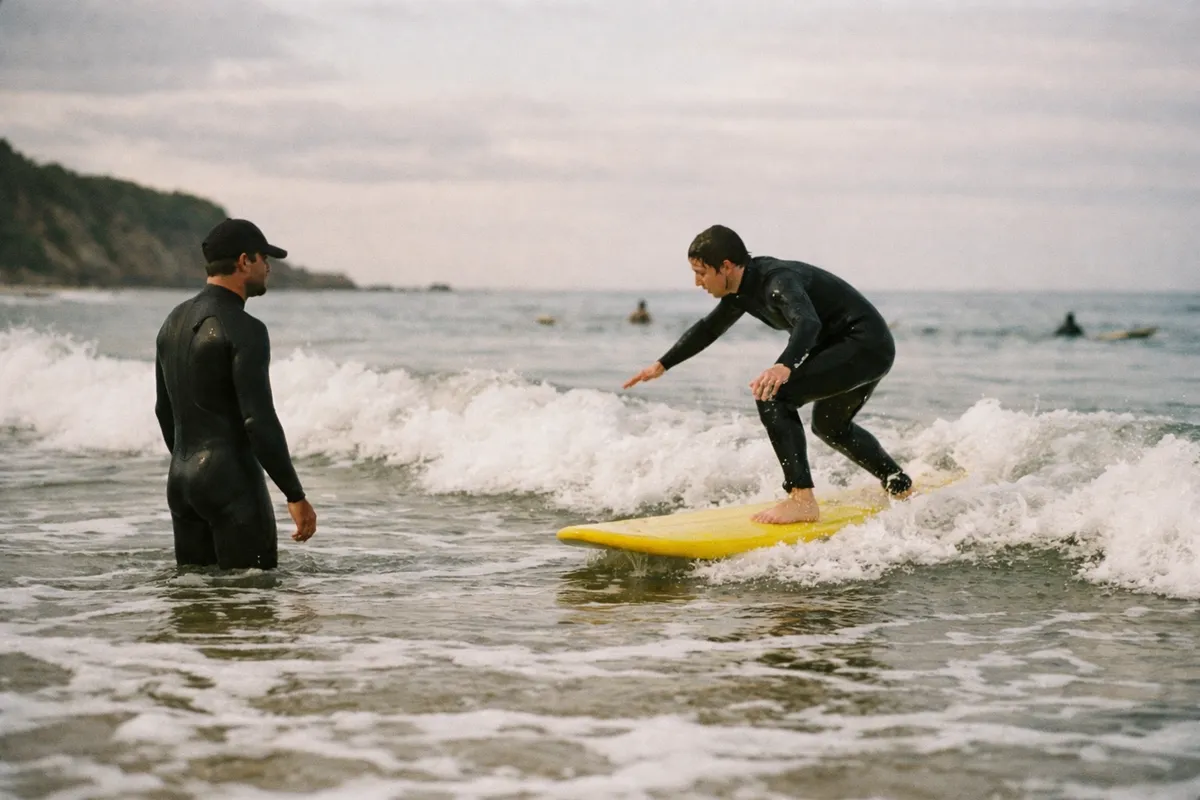
- Lessons at the right moments. First session (fundamentals), session 20 (first technique check), session 60 (intermediate transition).
- Tracking sessions. Write down what worked and what didn't. Patterns emerge fast. Surfyx does this automatically if you log your sessions.
- Fitness. Strong shoulders, strong back, strong core. Swimming helps a lot. So does yoga.
- Surfing with someone slightly better. You'll unconsciously copy their timing and positioning.
- Trips to good beginner waves. A week in Bali, Morocco, or Costa Rica can equal two months at home.
The plateau after month 6
Almost everyone hits a plateau somewhere around the 60–80 session mark. You've gone from falling constantly to standing confidently, and now you're stuck — the next skills (reading waves, making turns, managing crowds) are invisible to the untrained eye and take longer to build.
This is where a lot of people quit, and it's the worst time to quit. The breakthrough to "real" surfing happens on the other side of this plateau. Book another private lesson, get specific feedback, and keep showing up.
The answer you probably wanted
"How long does it take to learn to surf?" — six months, surfing twice a week, with 2 or 3 lessons in the first month. If you can commit to that, you'll be a surfer in time for next summer.
Start with our complete beginner's guide, book your first lesson, and log your sessions on Surfyx. Six months from now you'll be able to look back at the data and see exactly how far you've come.