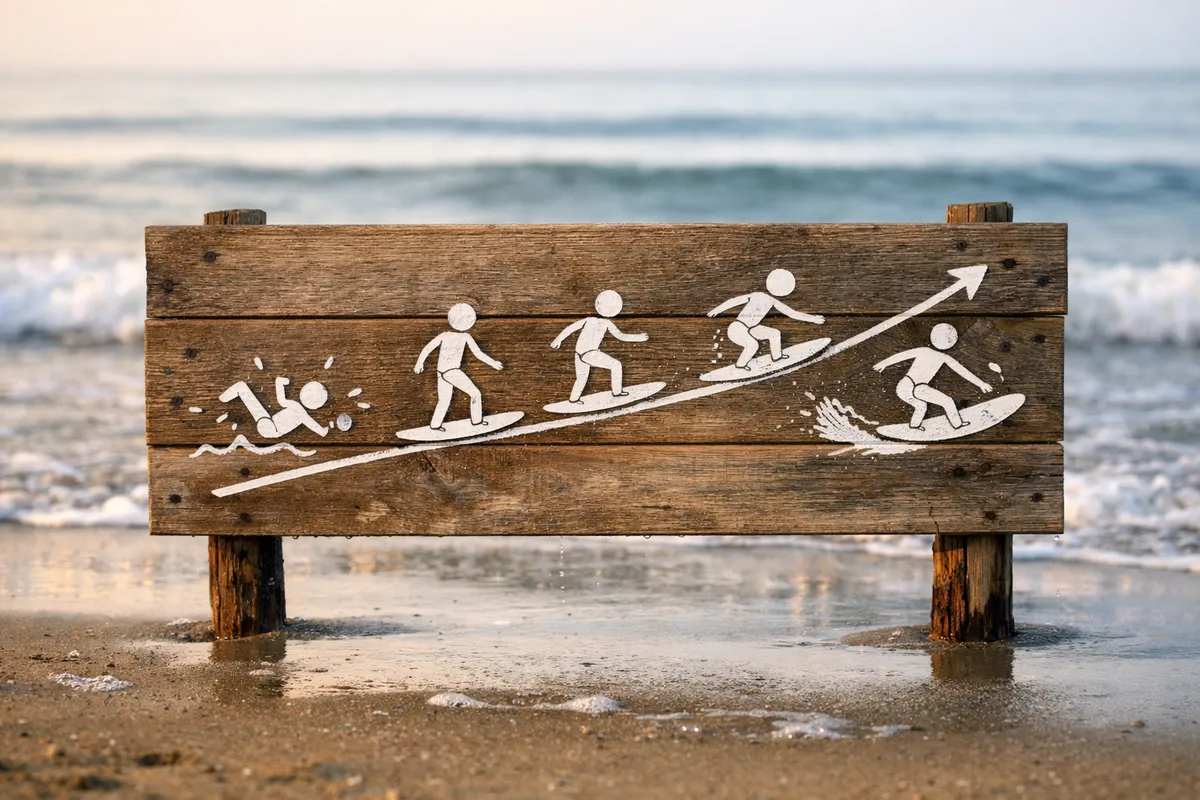
The first surfboard you ride will either speed up your progression or slow it down for months. Most beginners who quit surfing within their first three months quit because of the board, not because of surfing itself. They couldn't catch waves, they fell constantly, they got frustrated — and the real reason was the equipment.
Here's how to pick a first board that actually helps.
The one-paragraph answer
Rent an 8-foot soft-top longboard for your first month. If you decide to keep surfing, buy a used 8 to 9-foot soft-top longboard in the $200–400 range. Do not buy anything that looks like the boards pros ride. Do not let anyone convince you that a fish or a hybrid or a shortboard is the right "first board". It isn't.
If you just wanted the answer, you can stop reading. If you want to understand why, keep going.
Why shortboards are wrong for beginners
Every beginner wants a shortboard. They look cool. They're what the pros use. They promise you'll progress faster. They won't.
Shortboards are 5.5–6.5 feet long and very thin. They have low volume, meaning they barely float. Paddling is slow. Catching waves requires precise timing and strong paddling — neither of which a beginner has yet. Standing up on a shortboard requires the wave to already be moving fast under you, which means it needs to be a bigger wave than a beginner should be surfing.
The result: a beginner on a shortboard catches maybe one wave per session, falls off on the pop-up because the board is twitchy, and concludes they're "bad at surfing". They're not. They're on the wrong board.
Every professional surfer you've ever watched learned on a longboard or a foamie. Kelly Slater did. John John Florence did. Every single one. They switched to shortboards when they could already surf.
Why a soft-top is right
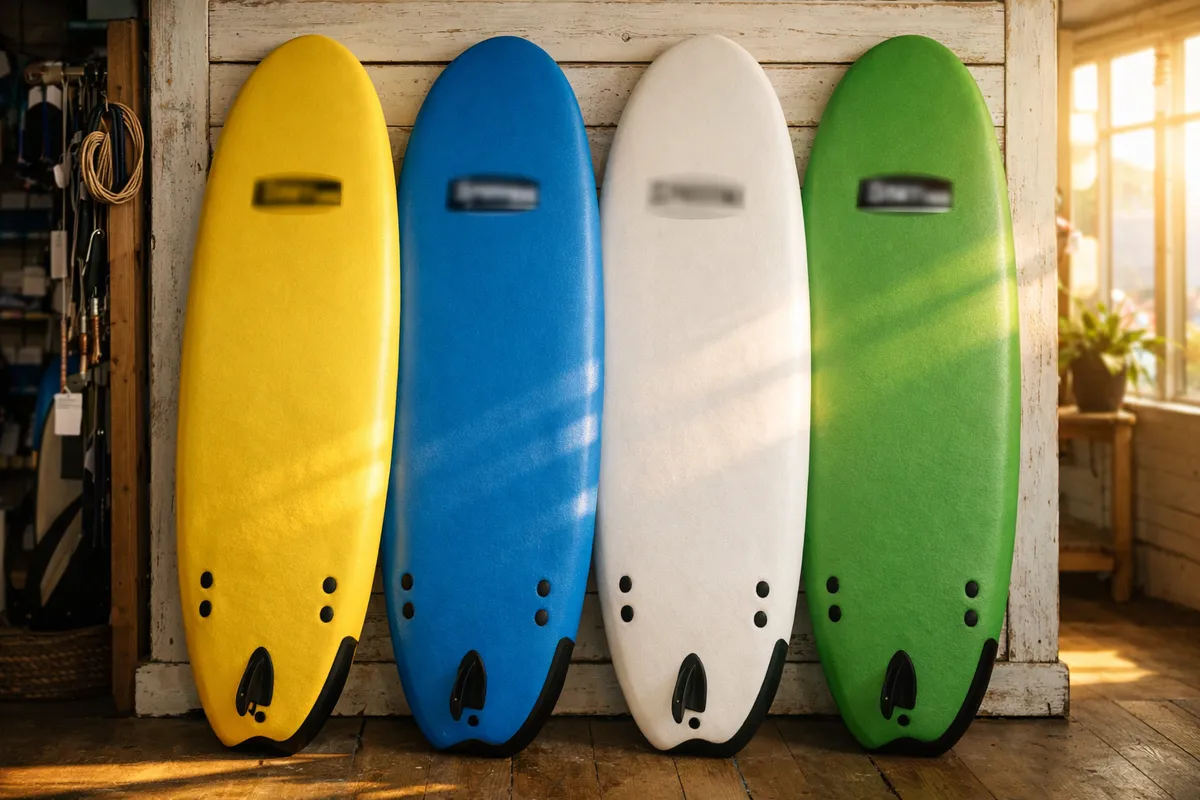
A soft-top (also called a "foamie" or "softboard") is a longboard made of foam, with a foam deck and slick plastic bottom. They look like pool toys. They also outperform every other board type for beginners by a wide margin.
Volume: soft-tops float you high on the water, which makes paddling faster and wave-catching easier.
Width: soft-tops are wide (21"+ typically), which makes standing up much more stable. Beginners fall off narrow boards constantly.
Forgiveness: foam doesn't hurt when it hits you. You will get hit. A lot.
Durability: soft-tops absorb dings that would crack a fiberglass board. A well-treated soft-top lasts years.
Resale: a used soft-top in decent shape sells easily on local surfer-to-surfer markets, which means the one you buy isn't a total sunk cost.
Sizing
Surfboard sizing is measured by length, width, thickness, and volume. For your first board, focus on length and volume.
Length by body size
- Under 60 kg / 130 lb: 7'6" to 8' soft-top
- 60–75 kg / 130–165 lb: 8' to 8'6" soft-top
- 75–90 kg / 165–200 lb: 8'6" to 9' soft-top
- 90 kg+ / 200 lb+: 9' or longer
When in doubt, go longer. Longer boards paddle faster, catch waves earlier, and are more stable when you stand up. The only downside of length is harder carrying and slightly less maneuverability — both of which a beginner doesn't care about.
Volume
Board volume is measured in liters and expresses how much foam is in the board. For beginners, higher volume = easier wave catching. A rough rule: your first board should have 2× your body weight in kilograms, expressed as liters. So a 70 kg person wants a board around 140 liters. Soft-top longboards in the 8' range are typically 85–120 liters, which is in the right ballpark.
Don't obsess over volume at this stage. Length and width matter more. Volume becomes critical when you start choosing smaller boards later.
Width and thickness
Wider boards are more stable. Thicker boards float more. For a first board you want both — minimum 21" width, minimum 3" thickness. Most soft-top longboards are 22–23" wide and 3.25–3.5" thick. Perfect.
Buying new vs used
New soft-top
A new 8-foot soft-top from a reputable brand (Wavestorm, Torq, Catch Surf, BIC, Softech, Gnaraloo) runs $300–500. Wavestorms from Costco sometimes go for $200 new — yes, they're genuinely fine for beginners, don't be snobby about it.
Budget pick: Wavestorm Classic 8' — $200
Mid pick: Torq TET 8' Longboard — $450
Premium pick: Catch Surf Odysea Log 8' — $500
All three will get you to month 6 with zero problems.
Used soft-top
A used soft-top in decent shape goes for $150–300. Check Facebook Marketplace, local surf shop used racks, and any surfer-to-surfer forums in your area. What to inspect:
- Deck: minor dents are fine, deep gouges or exposed stringer is not
- Rails: foam should still spring back when pressed
- Tail: check the fin boxes are intact and not wobbly
- Bottom: the slick plastic should be unbroken; cracks mean water has entered the foam
- Weight: if it feels significantly heavier than a new one, it's waterlogged — walk away
When to upgrade
Most beginners think they'll "outgrow" their soft-top in a few months. Almost no one actually does. Here's when the upgrade is legit:
- You've surfed 60+ sessions (not 10)
- You consistently catch unbroken waves on your own
- You can angle the board along the wave rather than going straight
- Your current board feels too stable — you can't turn it sharply enough for what you want to do
If any of those aren't true, you're not ready. Skipping ahead to a shorter board will slow your progress.
When you do upgrade, the typical next board is a funboard or mini-mal — 7 to 7'6" long, still plenty of volume, but narrower and more maneuverable than a foamie. Not a shortboard. Not yet.
What about epoxy? Fiberglass? Brand names?
Ignore all of it for now. For your first board, the categories that matter are "soft-top longboard" and "anything else". Pick a soft-top longboard and move on.
Once you upgrade to your second board, then you start caring about epoxy vs polyester, about tails, about fins, and about who made it. Not yet.
Where to shop
Your local surf shop is your best resource for buying your first board. They know the local conditions, they can size you up in person, and they'll often take your board in trade when you upgrade.
On Surfyx, surf products are listed by verified shops around the world. Filter by category "surfboards" and by region to find local sellers.
Summary
- Rent a soft-top longboard for your first month
- If you stick with surfing, buy an 8–9 foot soft-top longboard (new or used, $200–500)
- Size by body weight: longer and wider is always better for beginners
- Don't buy anything that looks like a pro shortboard for at least 60 sessions
- Upgrade only when you can legitimately ride unbroken waves on the foamie
For the complete beginner picture, read our full gear guide and the complete beginner's roadmap.