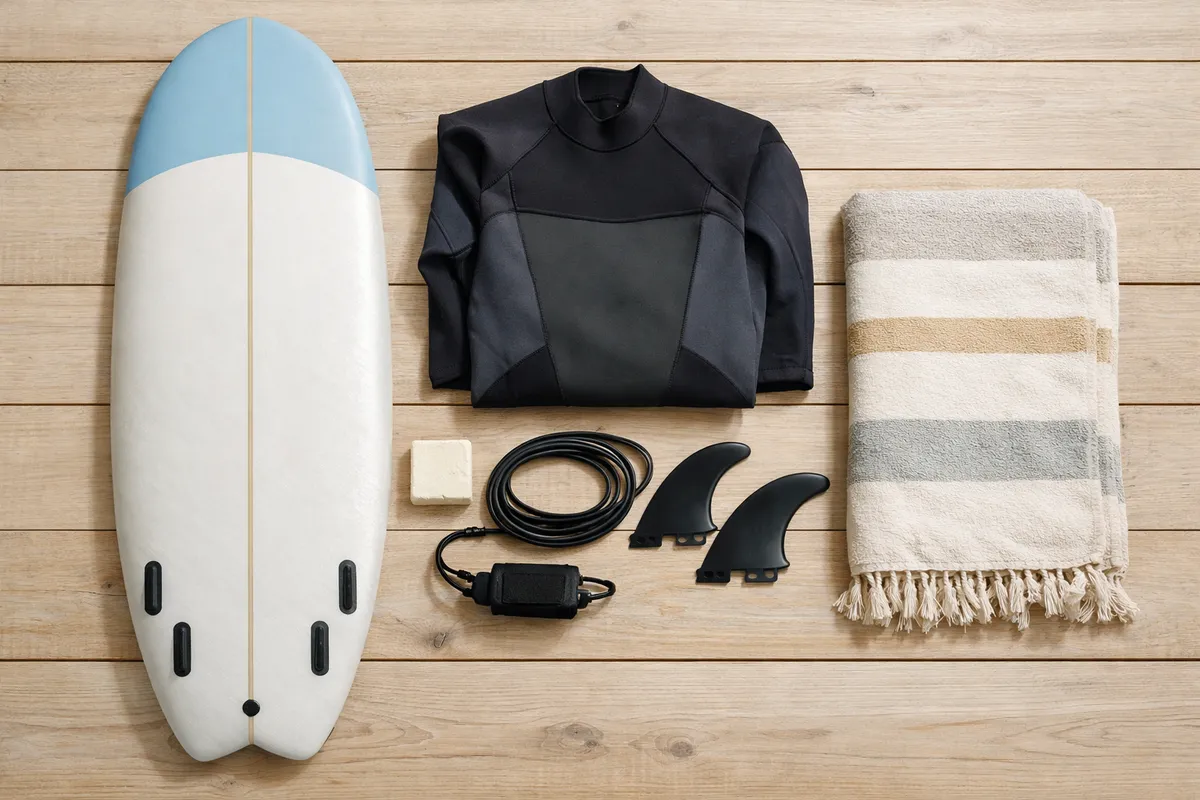
Before you spend a single euro, dollar, or peso on surf gear, read this. Most of what surf shops sell you in your first visit is either unnecessary, wrong for your level, or both. Here's what every piece of surf equipment actually is, when you need it, and the single most important advice: rent for your first month.
The rent-first rule
Your first month of surfing will teach you more about what gear you actually need than any article, salesperson, or YouTube video ever will. You'll discover whether you're a regular or goofy stance, whether you prefer long or short sessions, whether you're sticking with it at all.
Renting costs $15–30 a day. Buying a full setup costs $600–900. Eight rental sessions = $150. If after a month you're still hooked, buy. If you're not, you saved yourself $750 and a storage problem.
There's only one exception: if you're certain you'll be surfing 3+ times a week for a year, skip ahead to the buying section.
The board
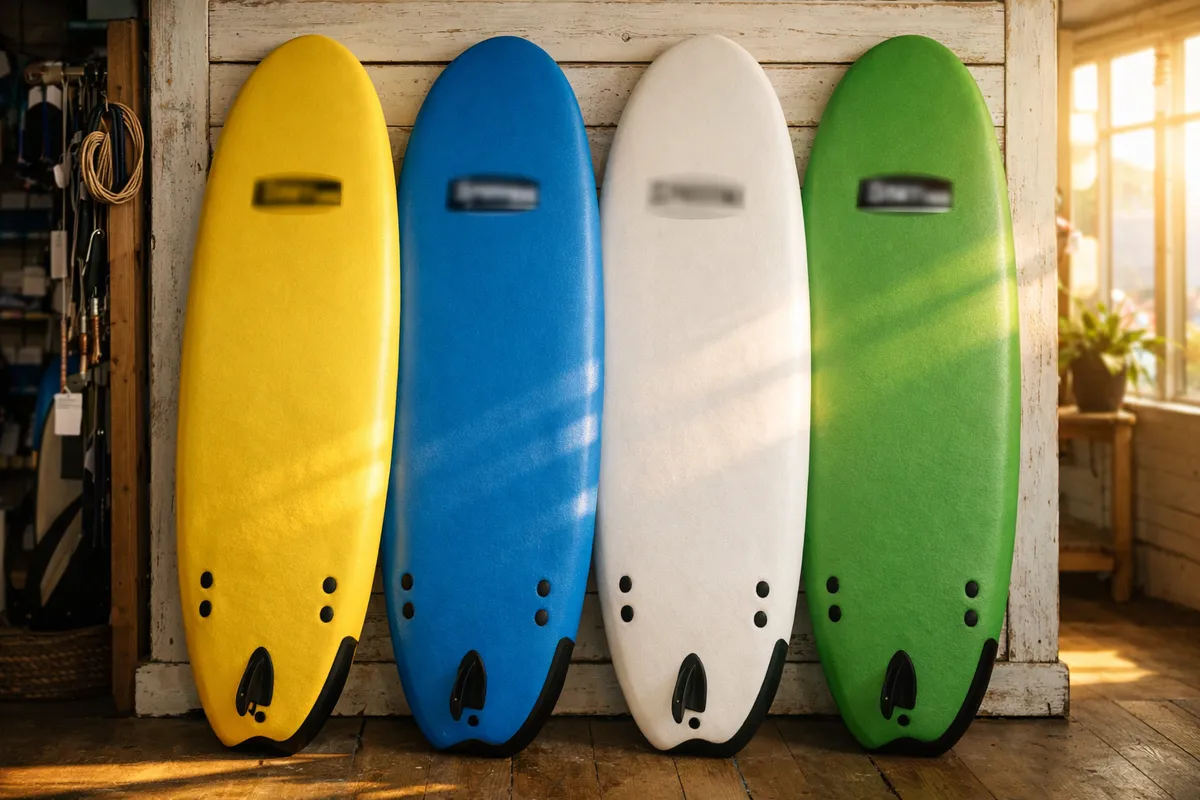
Your first board should be a soft-top longboard, 8 to 9 feet long, foam-covered top and bottom. Don't buy anything else. Don't let anyone talk you into a shortboard. Don't listen to a cousin who learned on a fish.
Why:
- Volume — more foam means more flotation, which means more wave-catching ability at beginner paddle speeds
- Stability — the width makes it much harder to fall off once you're up
- Forgiveness — when the board hits you (and it will), soft beats fiberglass every time
- Progression — everyone learns on a soft-top. It's not a shortcut; it's the road
Brand doesn't matter much at this stage. Wavestorm, Catch Surf Odysea, BIC Sport, Torq TET, and generic rental soft-tops are all fine for your first month. Rent before you buy. See our first surfboard guide for a detailed walkthrough of which sizes fit which body types.
The wetsuit
Unless you're in tropical water (25°C+ / 77°F+), you need a wetsuit. The suit traps a thin layer of water against your skin that your body warms, so the thicker the suit the longer you can stay in cold water.
Picking the right thickness
Wetsuits are labeled with two numbers, like "3/2 mm" — the first number is the torso thickness, the second is the arms and legs. Thicker torso for warmth, thinner arms for flexibility.
- Warm water (22°C+ / 72°F+): rash guard or 2 mm shorty
- Cool water (18–22°C / 64–72°F): 3/2 mm fullsuit
- Cold water (13–18°C / 55–64°F): 4/3 mm fullsuit, possibly booties
- Very cold (9–13°C / 48–55°F): 5/4 mm plus hood and booties
- Arctic-level (below 9°C / 48°F): 6/5 mm plus hood, booties, gloves, and a hot shower waiting
For your first month, rent a wetsuit from the same shop as your board. $5–10 per rental. You'll find out what thickness you really need before you spend $150+ on one.
Fit
Wetsuits should be tight. Uncomfortably tight at first, in fact. If there's any slack, cold water flushes through and you won't stay warm. The tight fit is why most beginners think their first wetsuit is too small — it isn't.
Get one that fits snug around the torso, arms, and legs with no bunching. The zip should close fully without straining. If you can pinch an inch of neoprene off your chest, it's too big.
Brands worth knowing
For beginners: O'Neill, Rip Curl, Xcel, Billabong, Vissla, Buell, and Need Essentials all make reliable entry-level suits. Premium brands like Patagonia R-series are beautiful but overkill for your first year.
The leash
A leash is the cord that attaches your back ankle to your board so when you fall, the board doesn't drift to shore or, worse, hit someone else. Non-negotiable.
Leashes are sized in feet. Match the leash length to your board length — a 9-foot board gets a 9-foot leash, a 6-foot board gets a 6-foot leash. Thicker leashes ("comp" vs "standard") are for bigger waves. For beginner conditions, a standard 7–9 foot leash is perfect.
Rental boards come with a leash. Once you buy, budget $25–40 for a decent one. FCS, Creatures of Leisure, Dakine, and Ocean & Earth are the main trusted brands.
The wax
Surfboard wax goes on top of your board to give your feet grip. Without it, your board is slippery when wet (it is wet) and you will slide off. Soft-tops often don't need wax because the foam is already grippy; hard boards definitely do.
Wax comes in temperature grades:
- Tropical — water above 24°C / 75°F
- Warm — 18–24°C / 64–75°F
- Cool — 13–18°C / 55–64°F
- Cold — below 13°C / 55°F
Use the wax that matches your water temperature. Wrong-temperature wax either slides off your board in the sun or turns rock-hard and has no grip.
A fresh board gets a base coat (rub a bar all over in circles until you see little bumps), then a top coat before each session. Budget: $3–5 per bar, a bar lasts 3–5 sessions. Sex Wax, Sticky Bumps, and Mr. Zog's are the classic brands.
Fins
Your board has 1, 2, or 3 fins screwed or clicked into the bottom. They provide directional control. Most soft-tops come with fins already installed and you never think about them.
Hard boards often have removable fins ("FCS" or "Futures" systems). If you buy a used hard board, make sure it comes with fins — otherwise you'll spend another $60–120 on a set.
Don't swap fins until you've been surfing for a year. It's a classic beginner mistake to fiddle with fin setups before you can actually feel the difference.
Everything else
Rash guard
Rash guards are tight lycra shirts that protect you from a) sunburn and b) the rash you'll get rubbing your chest and armpits against the board. If you're surfing in warm water without a wetsuit, wear one. Budget: $20–50.
Wax comb
A small plastic tool with a straight edge and a comb. You use the straight edge to scrape old wax off and the comb to rough up new wax for better grip. Optional but cheap ($3).
Surf booties
Neoprene socks for cold-water or reef-break surfing. Skip these until you actually need them. In temperate water they're unnecessary; over reef they're mandatory.
Hood and gloves
Cold-water only. Under 13°C / 55°F. Ignore until you're freezing.
Ear plugs
Surfer's ear (exostosis) is a real condition caused by repeated cold-water exposure. It's rare before year 5 of cold-water surfing. If you're surfing in cold water regularly, budget $10–30 for a pair of surf-specific ear plugs (SurfEars, Doc's Pro Plugs, Mack's). If you're in warm water, don't bother.
Sunscreen
Reef-safe mineral sunscreen, SPF 50+. Zinc-based. Apply before you leave home, re-apply after every session. Budget: $15–30 per bottle. Surf-specific brands (Sun Bum, Manda, Vertra) stay on through water better than generic.
Fin leash / board rack / car rack / wetsuit hangers / board sock / board bag
Don't buy any of these in your first month. You'll know which you need by month 2.
What a reasonable first-month kit costs
If you rent everything:
- 8 rentals (board + wetsuit): $120–200
- Rash guard (if warm water): $25
- Wax (for non-soft-top sessions): $5
- Sunscreen: $20
- Total: ~$150–250
If you buy after month 1 and stick with it:
- Used soft-top longboard: $200–400
- Wetsuit (3/2 mm): $120–200
- Leash: $25
- Wax: $5
- Fins (if needed): $60
- Bag (optional): $50
- Total: ~$460–740
Compare to the "premium beginner" kit a shop will try to sell you on day one — often $900–1,200. Big savings available to people who wait.
Where to shop
For beginners, prioritize local surf shops. They'll steer you away from gear you don't need, they know your local conditions, and they'll often take a used board in trade when you upgrade.
Used gear from local surfers is almost always the best value. Check Facebook groups, Craigslist equivalents, and any local surfer-to-surfer forums. Inspect the board in person for cracks, dings, and fin box damage.
On Surfyx, rentals near you are listed with upfront pricing, and products are listed by verified local shops.
Next reading
- Choosing your first surfboard — detailed breakdown of board sizes and shapes
- How to learn to surf — the complete beginner's roadmap
- How much does a surf lesson cost — pricing by region