Every surfer has thought about it at least once: what if I could do this for a living? Wake up, check the forecast, teach a few lessons, surf in the afternoon, repeat. It's one of the most appealing lifestyle careers in the world.
It's also a real job with real requirements — certification, first aid training, insurance, physical fitness, and the ability to communicate with people who are scared of the ocean. Here's what the path actually looks like.
Prerequisites
Before you can certify as a surf instructor, you need:
- Intermediate surfing ability. You need to comfortably catch green waves, ride along the face, perform basic turns, and handle a variety of conditions. You don't need to be a pro, but you need to be confident in the water.
- Ocean swimming fitness. Most certification courses require you to swim 400 meters in open water and tread water for extended periods. Some require a timed ocean swim.
- First aid and CPR certification. Usually required before the course or offered as part of the package. Must be current (within 2 years).
- Minimum age. Usually 18, though some organizations offer junior instructor certifications from age 16.
You do not need to be a competition surfer. Teaching ability and water safety are more important than your best aerial.
Certification paths
ISA (International Surfing Association)
The global standard. ISA runs instructor courses in dozens of countries, and the certification is recognized worldwide. The course is typically 5–7 days and covers:
- Surf-specific coaching methodology
- Water safety and rescue techniques
- Risk assessment and environmental awareness
- Teaching progressions (from complete beginner to intermediate)
- Practical assessments (you teach a real lesson, observed by assessors)
- Written exam
Cost: $500–1200 depending on location. Includes the course, assessment, and certification card.
Validity: ISA certifications need renewal every 2–3 years, including updated first aid.
Surfing Australia
The Australian equivalent. Recognized throughout Australasia. Similar structure to ISA with additional focus on Australian-specific hazards (rip currents, marine life). Required for teaching in Australia.
Cost: AUD 600–1000.
BSA (British Surfing Association)
UK-specific. Offers Level 1 (assistant instructor) and Level 2 (full instructor) certifications. Level 2 is required to lead lessons independently.
Cost: £300–600 depending on level.
National federations
France (FFS), Portugal (FPS), Spain (FES), and other countries have their own instructor certification programs. These are usually recognized domestically and often cross-recognized within Europe.
The certification course — what to expect
A typical ISA instructor course runs 5–7 consecutive days. A typical day looks like:
- Morning: Theory session (teaching methodology, safety protocols, legal requirements)
- Midday: Practical water session (peer teaching, rescue drills, demonstration of skills)
- Afternoon: Assessment preparation, group discussions, scenario practice
The final assessment usually includes:
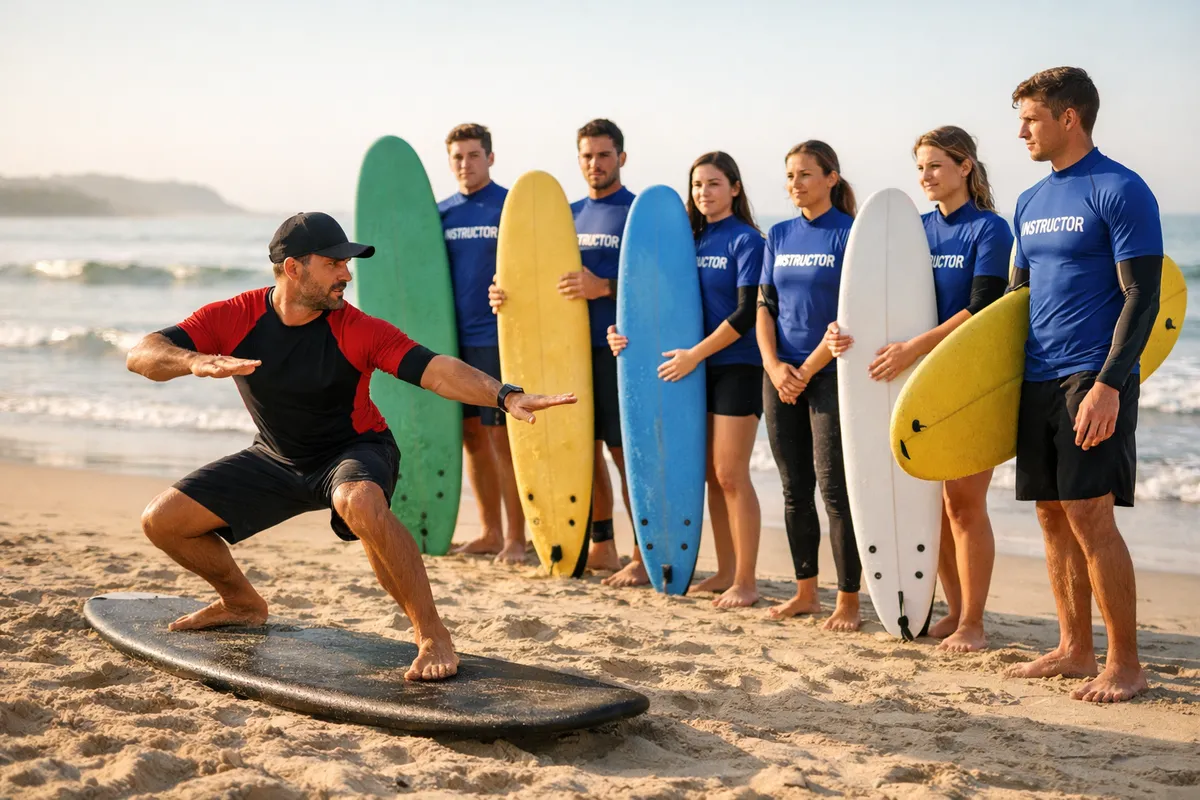
- A practical teaching assessment (you teach a real or simulated beginner lesson, graded on technique, safety, communication, and adaptability)
- A water skills assessment (demonstrate competent surfing and rescue ability)
- A written exam covering theory, safety, and first aid
Pass rates are typically 80–90%. Most failures are in the practical teaching component — good surfers who can't communicate or adapt their teaching style.
After certification — getting your first job
Surf schools
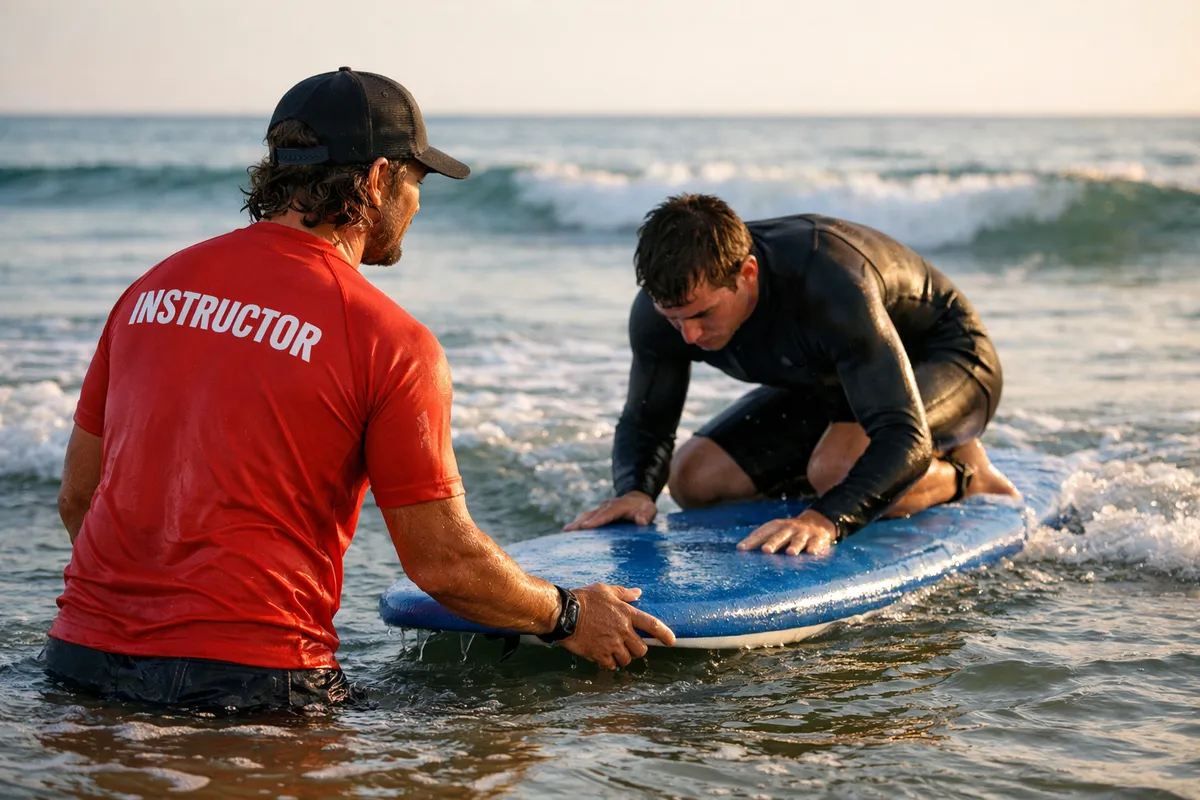
The most common entry point. Surf schools hire instructors seasonally (summer in Europe, dry season in Central America, year-round in tropical destinations). You'll teach group and private lessons, maintain equipment, and help with logistics.
How to find work:
- Apply directly to schools in the area you want to work
- List your credentials on Surfyx as an instructor — schools and students find you
- Network at certification courses — other trainees know who's hiring
- Start local. Your home break's schools are the easiest first hire.
Surf camps
Camps hire instructors for full seasons or year-round. The work is more immersive — you live on-site, teach 1–2 sessions per day, and participate in the camp community. Room and board are often included.
Freelance
Once you have experience and a client base, freelance instruction pays more per hour. You set your own schedule, choose your students, and keep the full lesson fee. The tradeoff: you handle your own bookings, insurance, equipment, and marketing.
Pay expectations
Instructor pay varies enormously by location:
| Location | Employed (per hour) | Freelance (per lesson) |
|---|---|---|
| Portugal / Spain | €12–20/hr | €40–80/lesson |
| France | €15–25/hr | €50–100/lesson |
| UK | £12–20/hr | £40–80/lesson |
| Australia | AUD 25–40/hr | AUD 80–150/lesson |
| California | $20–35/hr | $80–150/lesson |
| Costa Rica | $10–18/hr | $40–80/lesson |
| Bali | $8–15/hr | $25–50/lesson |
Most entry-level instructors at schools earn enough to live modestly in the area — not enough to save significantly. It's a lifestyle trade, not a wealth-building career. Freelance instructors with strong reputations can earn significantly more, especially in expensive markets.
Career progression
Surf instruction has a career ladder:
- Level 1: Assistant instructor (helps a lead instructor)
- Level 2: Full instructor (leads lessons independently)
- Senior instructor / head coach: Manages other instructors, designs curriculum, handles assessment
- School owner / operator: Runs the business side — permits, insurance, marketing, staff
- Examiner / coach educator: Trains and certifies new instructors (ISA, national federations)
Additional qualifications that increase your value:
- Lifeguard certification (RLSS, SLSA, etc.)
- Adaptive surfing instructor (teaching people with disabilities)
- Coaching for competition (requires separate certification in most countries)
- Water safety / jet ski rescue (for big-wave environments)
The reality of the job
The good:
- You surf almost every day
- You work outdoors in beautiful places
- Watching someone stand on a wave for the first time never gets old
- The community is tight and international — you make friends everywhere
- Seasonal work lets you chase different coastlines through the year
The hard:
- Physical wear. You're in the ocean 4–8 hours a day. Shoulders, knees, skin — it adds up.
- Seasonal income. Many instructors work 6 months and need another income source for the off-season.
- Repetition. Teaching the same pop-up 10 times a day for months requires patience.
- Weather dependence. Bad conditions mean cancelled lessons and lost income.
- Low starting pay. The first few years are financially tight.
Getting started — a practical timeline
- Month 1–3: Get your surfing to a solid intermediate level. Swim regularly. Get first aid certified.
- Month 4: Take an ISA (or equivalent) instructor course.
- Month 5–6: Apply to schools in the area you want to work. Start with the upcoming season.
- Year 1: Work at a school. Learn the operational side. Build your teaching skills.
- Year 2+: Specialize (private lessons, advanced coaching, adaptive surfing) or go freelance.
List yourself as an instructor
On Surfyx, create an instructor profile with your certifications, reviews, and lesson offerings. Students search by location and credentials — your profile is your storefront.