The difference between a great first surf experience and a terrible one is almost always the instructor — not the waves, not the equipment, not the weather. A great instructor reads you, adapts, puts you in the right position, and gets you standing up with a grin on your face. A bad one recites the same script to every student, watches from the beach, and hopes the whitewater does the teaching.
If you're about to book your first lesson, here's what to look for — and what to avoid.
The fundamentals
Certification
A certified surf instructor has been trained and assessed in:
- Water safety and rescue — how to respond if you get into trouble
- First aid and CPR — current and up to date
- Surf-specific pedagogy — how to teach the pop-up, wave selection, positioning
- Risk assessment — reading conditions and deciding whether it's safe to teach
The main certification bodies:
- ISA (International Surfing Association) — the global standard. Recognized in most countries.
- Surfing Australia — the Australian standard. Equivalent to ISA in rigor.
- BSA (British Surfing Association) — UK-specific.
- National federation equivalents — France (FFS), Portugal (FPS), etc.
An uncertified instructor might be a great surfer, but surfing ability and teaching ability are completely different skills. Certification doesn't guarantee greatness, but it guarantees a baseline of safety competence.
Insurance
Legitimate instructors carry professional liability insurance. If something goes wrong — you get hurt, your board hits someone — insurance covers it. Ask before booking. If an instructor can't confirm they're insured, walk away.
Experience
Years of instructing matter more than years of surfing. An instructor who's taught 500 beginners knows exactly what mistakes you'll make, how to correct them in real time, and how to adapt when the standard approach doesn't work for your body type or comfort level.
What separates good from great
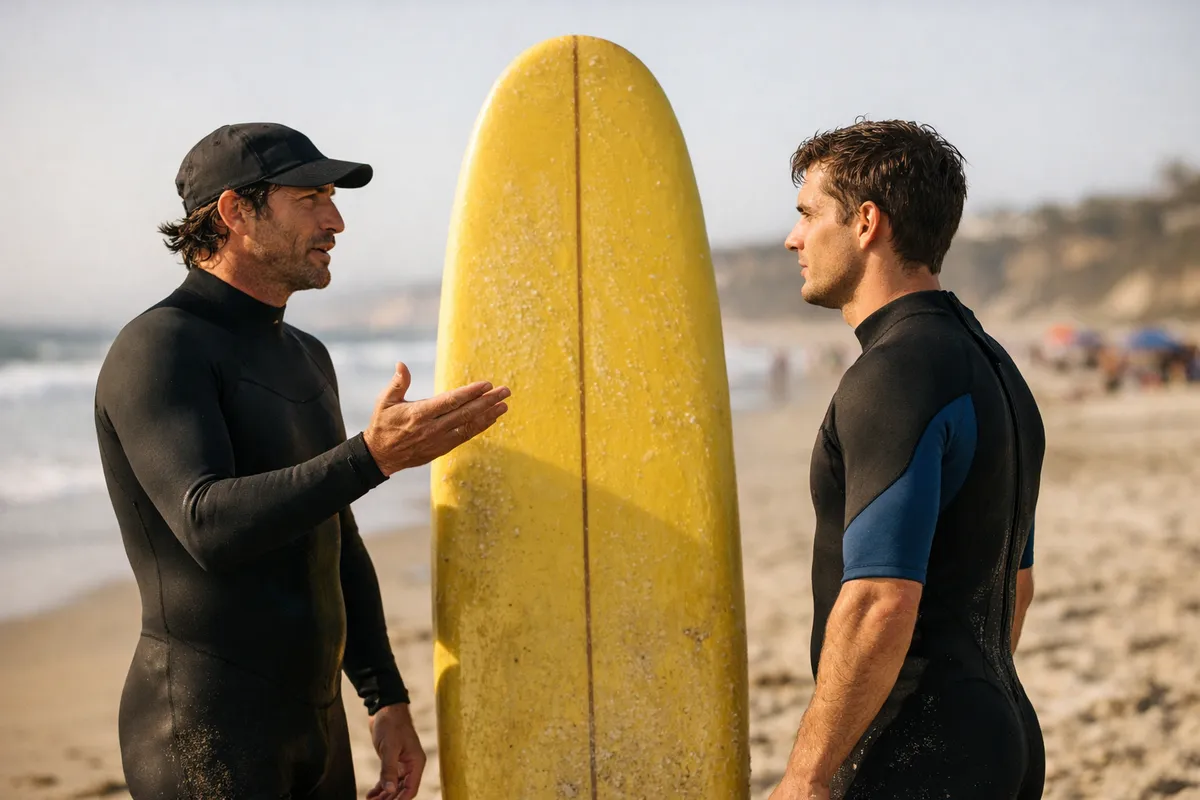
They assess you before the water
A great instructor starts on the beach — not with a canned speech, but with questions:
- Have you surfed before?
- How comfortable are you in the ocean?
- Any injuries or physical limitations?
- What are you hoping to get out of today?
This assessment determines which beach they choose, how deep they take you, what board size they give you, and how they pace the lesson. An instructor who skips this step is teaching a script, not a student.
They're in the water with you
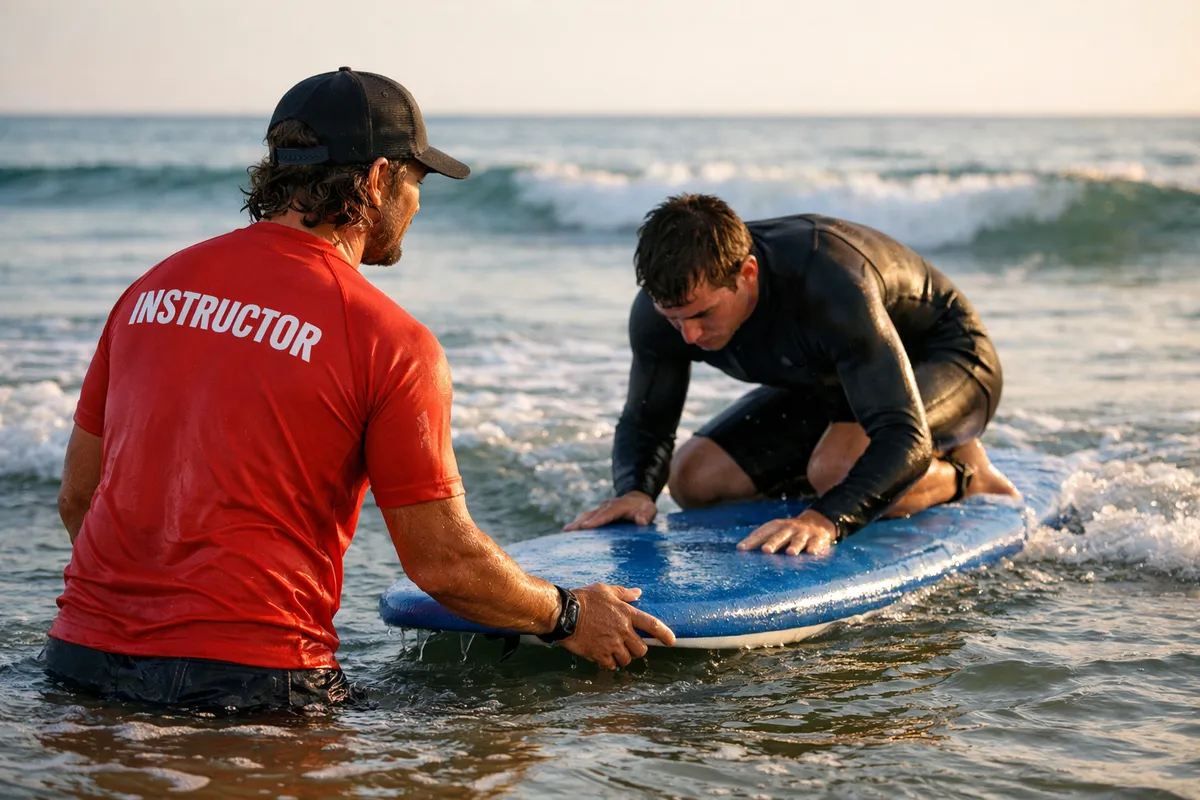
There are two types of lessons: instructor-in-the-water and instructor-on-the-beach. Great instructors are in the water — pushing you into waves, positioning your board, giving real-time feedback on your stance and timing.
An instructor standing on the shore with a megaphone can't see your weight distribution, can't adjust your board position, and can't catch problems before they become habits. For beginners, in-water instruction is dramatically more effective.
They adapt to your pace
Some students pop up on the first try. Others need 30 minutes of practice on the beach before they're comfortable in the water. A great instructor reads this and adjusts — they don't rush a nervous student, and they don't hold back a natural.
Signs of a great instructor adapting:
- Changing the board size mid-lesson if the first one isn't working
- Moving to a different section of the beach for better conditions
- Spending more time on the beach pop-up if you're not ready for water
- Giving you harder challenges if you're progressing fast
They explain the "why"
A mediocre instructor says "put your hands here." A great instructor says "put your hands here because if they're too far forward, you'll nose-dive when the wave catches you — the board will pearl and you'll go face-first."
Understanding why something works means you can correct yourself. It means the lesson lasts beyond the lesson.
They prioritize safety without killing the fun
Safety and fun aren't opposites. A great instructor weaves safety into the experience naturally:
- "We're going to surf here because the current pulls that way — if you get tired, just let it take you to the beach over there"
- "Cover your head when you fall — like this — because the board will bounce"
- "See that surfer? They have priority because they're closer to the peak. We'll wait for the next one"
A bad instructor either ignores safety entirely or makes it so scary that you're too anxious to enjoy yourself.
Red flags
- No certifications mentioned. If a school or instructor can't tell you their certification, that's a problem.
- Instructor stays on the beach for the entire lesson. You're paying for instruction, not supervision.
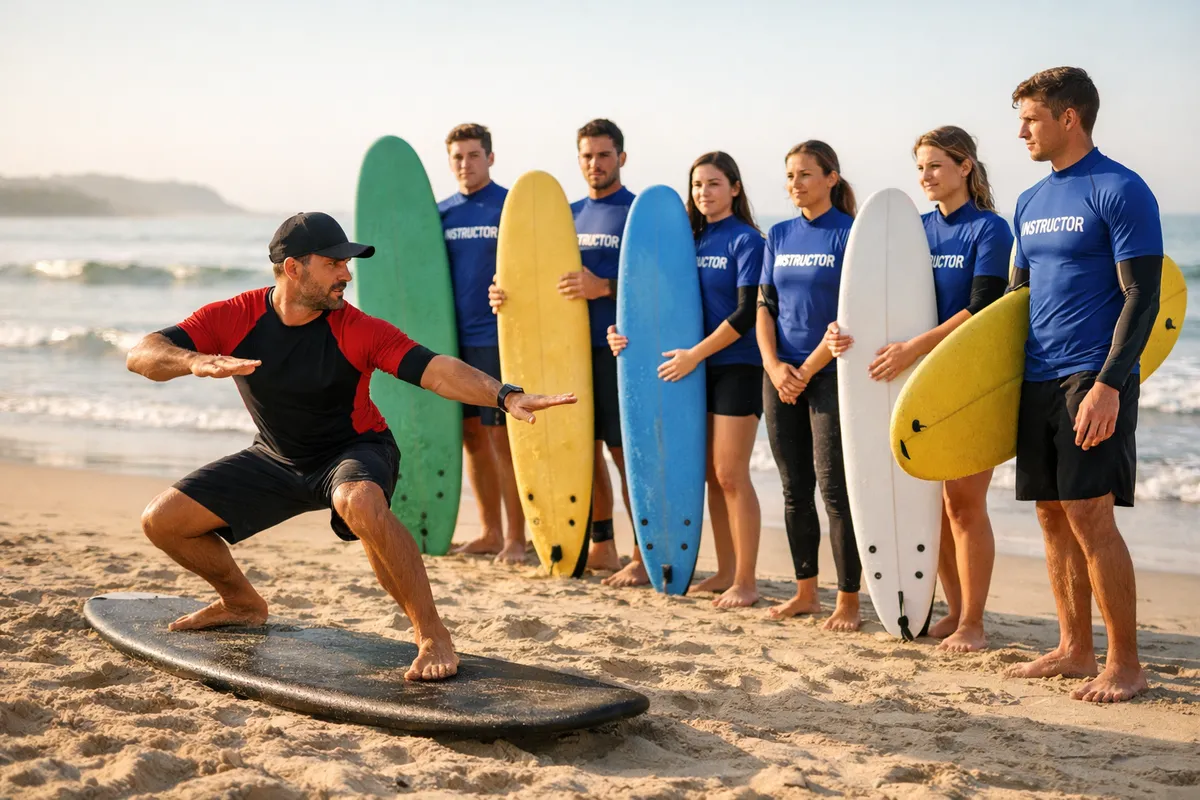
- Groups larger than 6:1. Above this ratio, you're not getting meaningful individual attention.
- No safety briefing. If nobody talks about rip currents, board handling, or the surf conditions before you enter the water, the safety standard is low.
- Pressure to book multi-session packages upfront. Good instructors let the first lesson sell the next one.
- Teaching at an inappropriate beach. If the waves are clearly too big or too powerful for beginners and the instructor takes you out anyway, they're prioritizing schedule over safety.
How to find a great instructor
- Check reviews. Look for reviews that specifically mention the instructor by name and describe the teaching quality — not just "had a great time."
- Ask about certifications and ratios. A school that's proud of these will answer immediately.
- Start with one lesson. Don't commit to a week-long package with an unproven school. Book one session, evaluate, then decide.
- Ask for a specific instructor. If reviews mention someone by name, request them when booking.
Private vs group instruction quality
Even a great instructor can't give you full attention in a group of 6. If your primary goal is maximum learning per hour:
- Private lesson (1:1): The most effective. Every wave is coached. Every rep gets feedback.
- Semi-private (1:2 or 1:3): Nearly as effective, and more fun if you're with a friend.
- Group (1:4 to 1:6): Good for a first introduction. Less individual feedback but more affordable and more social.
Read our full group vs private lessons guide for the detailed comparison.
The instructor's perspective
Great instructors love what they do. They've chosen a career that pays modestly because they genuinely enjoy watching someone stand on a wave for the first time. If you find an instructor who lights up when talking about teaching beginners, you've found a good one.
Tip them. Recommend them. Leave a review. The best way to find great instructors is for great instructors to be rewarded for being great.
Find verified instructors
On Surfyx, every listed instructor and surf school includes verified reviews, certification details, and upfront pricing. Compare instructors before you book, and leave a review after your lesson to help the next beginner.