Surf wax is the cheapest, simplest piece of equipment in surfing — and one of the most important. Without wax, your board is a wet, slippery surface that your feet can't grip. With properly applied wax, your feet stick to the board and you can focus on surfing instead of sliding.
It takes 5 minutes to learn and 3 minutes to do. Here's the full guide.
Why you need wax
Surfboards (hard boards, not soft-tops) have a smooth fiberglass or epoxy surface. When wet, they're extremely slippery. Wax creates a textured layer of small bumps that your feet grip against. Without it, you'll slip off every time you try to stand up.
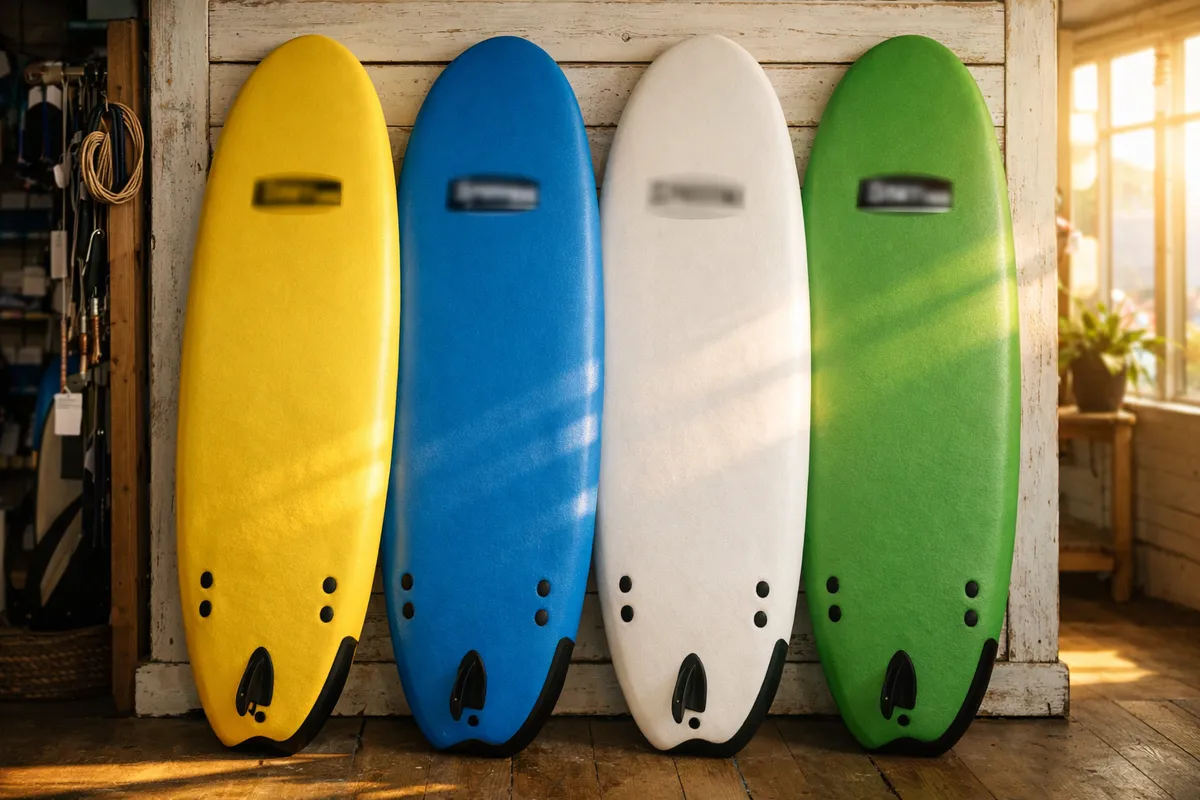
Soft-top foam boards usually don't need wax — the foam surface provides grip naturally. If your soft-top is slippery, a light wax coat helps, but it's not essential.
Temperature grades
Surf wax comes in different hardness grades matched to water temperature. Using the wrong grade means poor grip:
| Grade | Water temp | When to use |
|---|---|---|
| Cold | Below 14°C / 58°F | Northern Europe winter, NorCal |
| Cool | 14–19°C / 58–66°F | Portugal, SoCal spring/fall |
| Warm | 19–24°C / 66–75°F | SoCal summer, Morocco |
| Tropical | Above 24°C / 75°F | Bali, Costa Rica, Hawaii |
Why it matters: cold-water wax is soft. In warm water, it melts into a smooth, slippery film. Tropical wax is hard. In cold water, it doesn't create bumps because it can't soften enough to spread. Match the wax to your water.
When in doubt, ask the surf shop. They sell the right grade for local conditions.
Base coat vs top coat
- Base coat: A harder wax applied first, rubbed in all directions to create the initial bump pattern. This is the foundation. It lasts for weeks.
- Top coat: The temperature-matched wax applied over the base coat before each session (or every few sessions). Refreshes grip.
Some wax brands sell separate base coat bars. Others mark their tropical wax as suitable for base coating (it's hard enough). If in doubt, use a dedicated base coat bar for the first layer.
How to apply — step by step
New board (or freshly stripped board)
- Clean the surface. If it's a new board, it's already clean. If you stripped old wax, make sure no residue remains (use a wax comb or warm water).
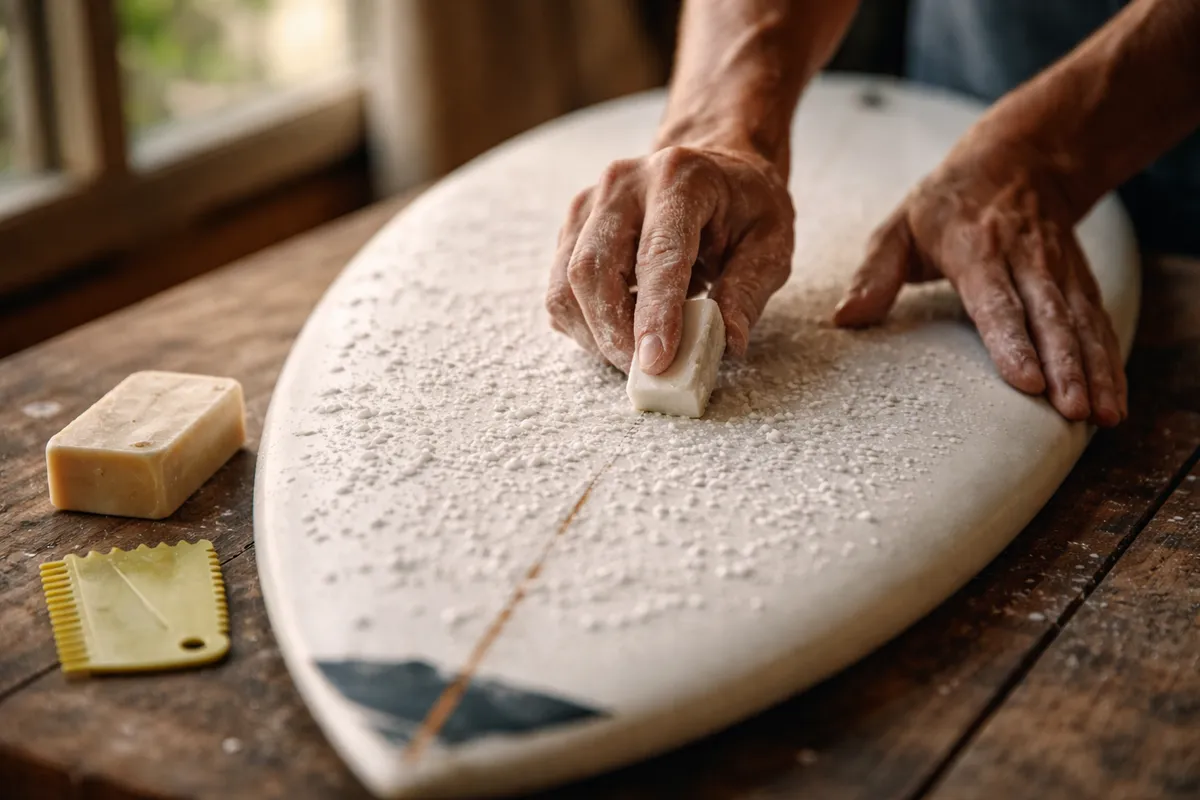
- Apply the base coat. Rub the base coat wax firmly across the deck (the top surface where you stand) in diagonal strokes — corner to corner, crossing in an X pattern. Press hard. You want to see small bumps forming.
- Switch to a circular motion. Once the diagonal strokes have created initial texture, go over the same area in small circles. The bumps will become more defined.
- Apply the top coat. Using the temperature-matched wax, rub lightly in circular motions over the base coat. Less pressure than the base coat — you're adding a thin sticky layer on top of the bumps.
- Cover the right area. Wax from the tail (back) to about two-thirds up the board — everywhere your feet and body contact. Don't wax the nose or the bottom.
Before a session (existing wax)
- Run the wax comb diagonally across the existing wax to rough it up and restore texture.
- Apply a few light circular strokes of top coat.
- Done. 60 seconds.
When to strip and rewax
Over time, wax accumulates dirt, sand, and dead skin. It loses its grip and becomes a brown, smooth layer instead of a bumpy one.
Strip and rewax completely when:
- The wax looks dirty and smooth (no visible bumps)
- You're changing water temperature (switching from cold to tropical wax)
- Every 2–3 months with regular use
How to strip wax
- Leave the board in the sun for 10–15 minutes. The wax softens.
- Scrape with the flat edge of a wax comb. Long strokes from nose to tail. The wax peels off in sheets.
- Clean residue with a wax remover liquid (coconut oil works too) and a cloth.
- Reapply base coat and top coat as above.
Common mistakes
- Not using a base coat. Top coat alone doesn't stick well and wears off fast.
- Using the wrong temperature. Cold wax in tropical water = soup. Tropical wax in cold water = no grip.
- Waxing the bottom. Never wax the bottom of the board — it creates drag and slows you down.
- Over-waxing. Too much wax builds up into a thick, smooth layer. Strip and restart when it gets thick.
- Storing the board in direct sun. Melts all the wax into a flat mess. Store in shade or a board bag.
Brands
Surf wax is one product where brand barely matters. They all work. The classics:
- Sex Wax (Mr. Zog's) — the most famous surf wax in the world. The coconut smell is iconic.
- Sticky Bumps — equally popular, slightly different texture.
- Fu Wax — Brazilian wax, very sticky, popular with pros.
- Matunas — organic/eco option.
A bar costs $3–5 and lasts 3–5 sessions. It's the cheapest consumable in surfing.
Traction pads — the alternative
Some surfers (mostly shortboarders) use adhesive traction pads on the tail instead of wax. The pad provides permanent grip without reapplication.
As a beginner on a longboard or foamie, you don't need a traction pad. They're designed for shortboard back-foot placement. Stick with wax until you're on a shorter board.