Every surfer hits the same plateau: you've been riding a soft-top for a few weeks, you're standing up consistently on whitewater, maybe even catching a few unbroken waves, and you start to wonder — is it time to switch to a real board?
The answer most of the internet gives you is wrong. "After 20 sessions." "Once you can angle." "Whenever you feel ready." These are all vague enough to justify whatever you already want to do, which is usually to switch too early.
Here's the honest framework — based on actual skills, not session counts or vibes.
The one sign you're ready
You're ready to switch from a soft-top to a hard board when you can consistently catch unbroken waves on your own, without being pushed, and ride along the wave rather than straight to shore.
That's it. If you can reliably do those two things for the entire session, the soft-top is holding you back and a narrower hard board will unlock the next level. If you can't, the hard board will erase the progress you've made.
The two things most people get wrong
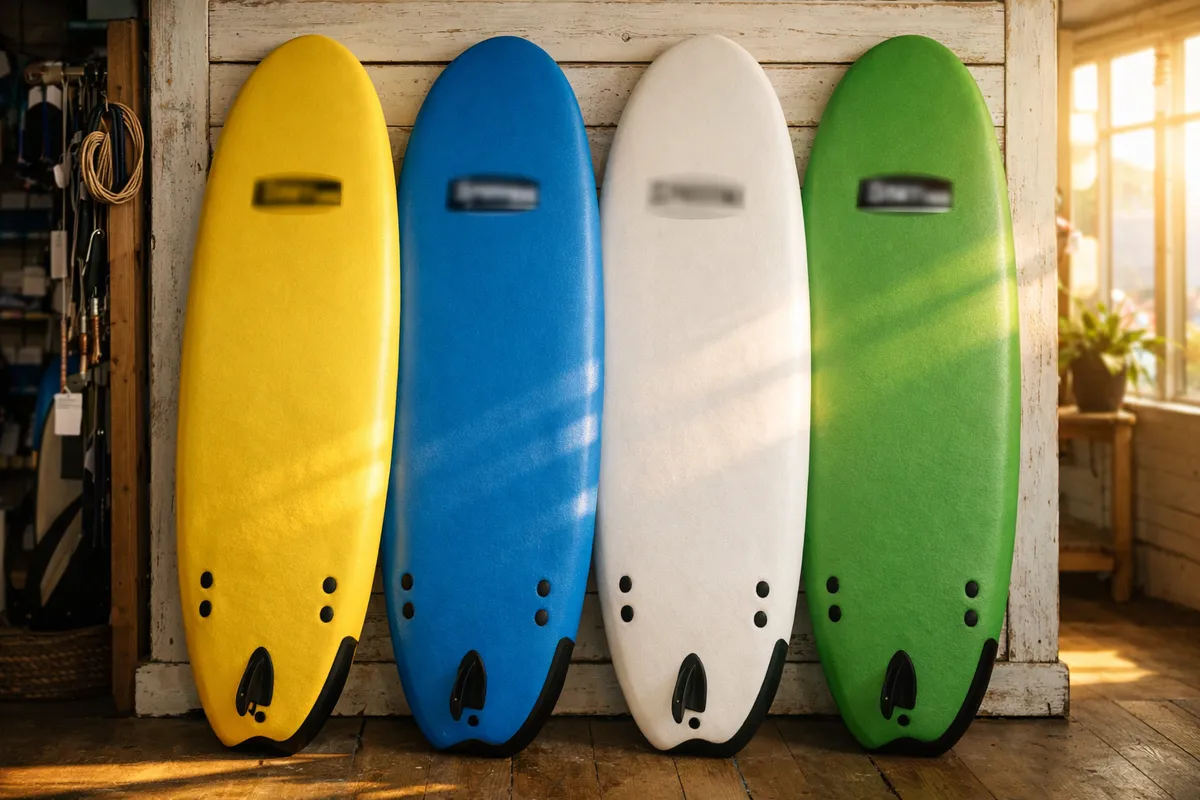
Mistake #1: confusing "I can stand up" with "I can surf". Standing up on whitewater is the very first skill, not the finish line. A soft-top is perfect for weeks 1–8 because it catches broken waves easily. If you can only stand up on whitewater, staying on the soft-top is the right call.
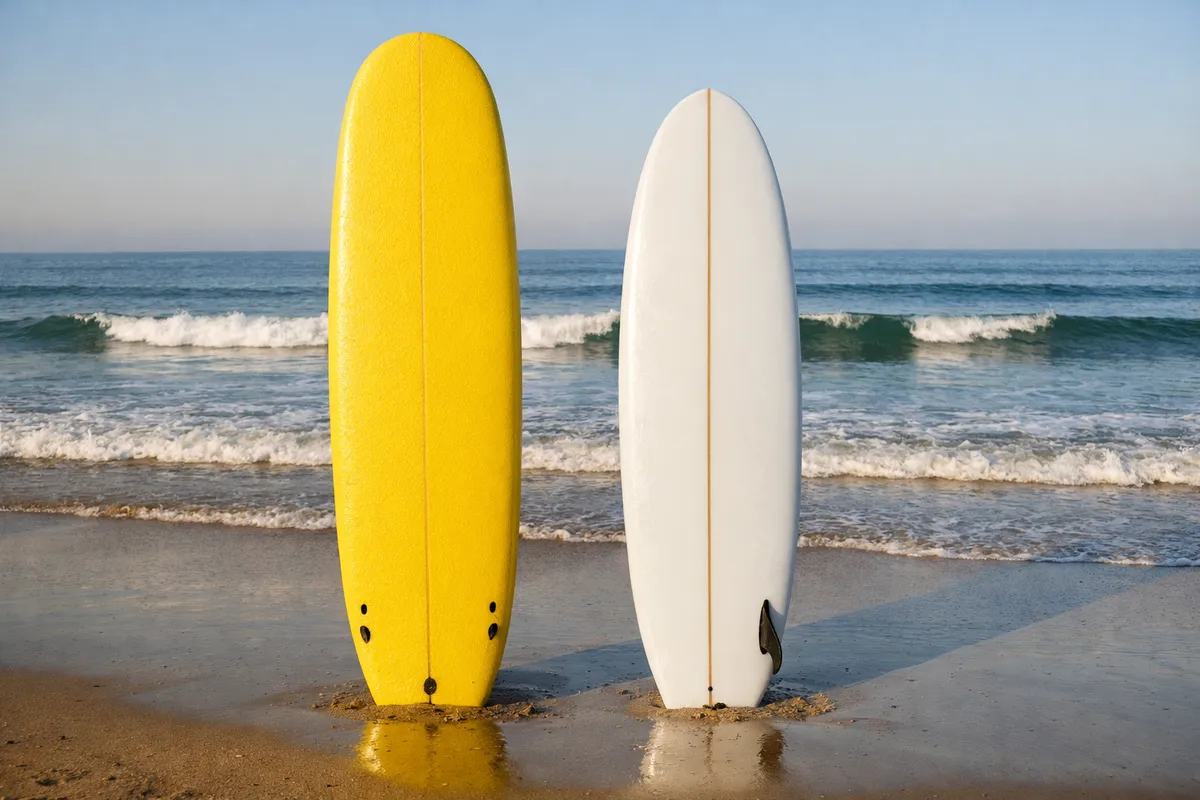
Mistake #2: buying a shortboard as a second board. This is the single most common error in intermediate surfing, and it's devastating. Shortboards are 5.5–6.5 ft. They have very low volume and require precise wave selection, strong paddling, and immediate timing — all of which you don't have yet. Going from 8 ft of foam to 6 ft of fiberglass is not an upgrade, it's a demotion that will take you months to recover from.
Don't skip the middle step.
The middle step: a funboard or mid-length
Your second board should be a funboard or mid-length — typically 7 ft to 7'6" long. Still plenty of volume, still forgiving enough to catch waves easily, but narrower than a soft-top and responsive enough that you can actually turn. This is the board every instructor recommends as the bridge from foamie to shortboard.
Characteristics to look for in your second board:
- Length: 7' to 7'6" for most adult bodies. 7'6" to 8' if you're over 90 kg.
- Width: 21" or wider. Still stable.
- Volume: 55–70 liters for most people. Rough rule: body weight in kg × 0.85.
- Shape: rounded nose ("egg" or "mini-mal" shapes are classic). Not a shortboard shape.
- Construction: epoxy or polyester both fine. Epoxy is lighter and more durable.
Milestones that tell you when
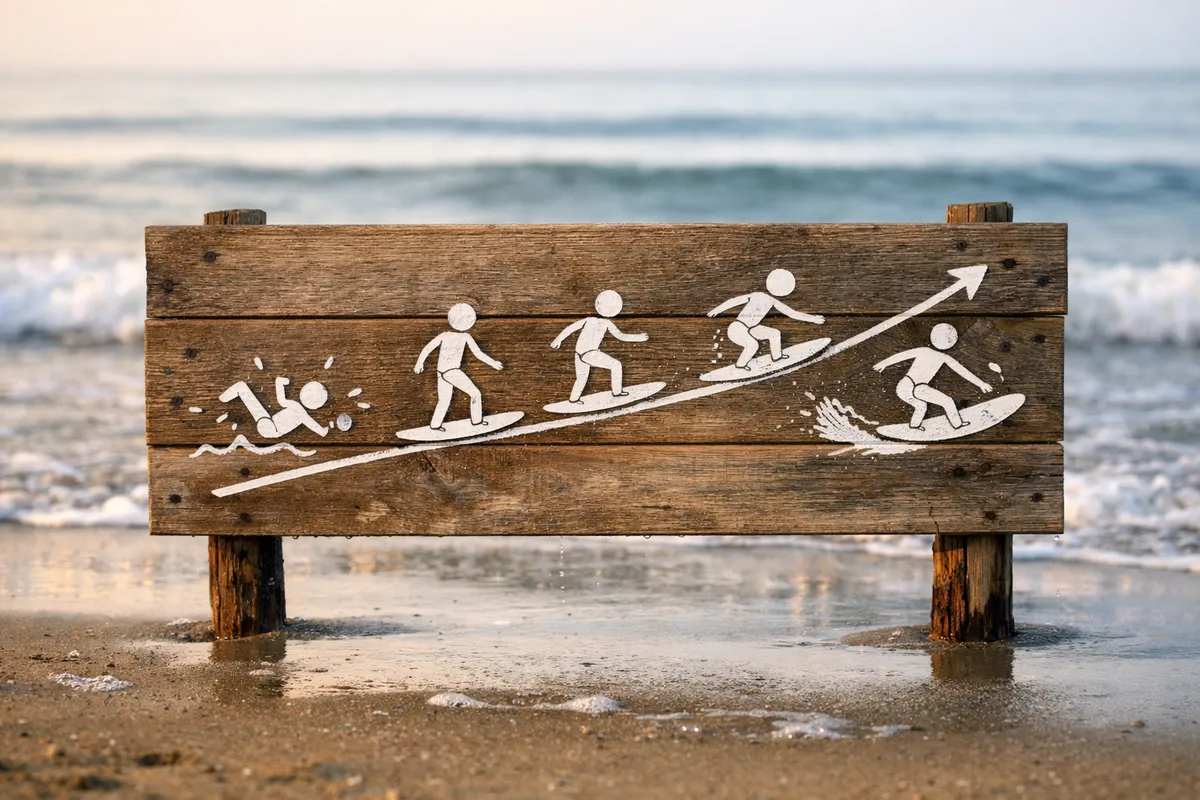
Not ready: you're still riding whitewater most of the time
Solution: keep the soft-top. Work on paddling for unbroken waves. Still falling on the pop-up? Still on whitewater.
Maybe ready: you can catch one or two unbroken waves per session on the foamie
Solution: keep the soft-top but start experimenting. Try renting a funboard for one session to see how it feels. If you catch waves on it, you're close. If you can't paddle into anything, you're not ready yet.
Ready: you catch unbroken waves most attempts, ride along the shoulder rather than straight
Solution: switch. A 7'6" funboard will let you start learning real turns, wave selection, and positioning. You'll regress for 3–5 sessions while you adjust to the different paddle feel and pop-up balance, then you'll break through.
Past ready: funboards feel too stable, too slow to turn
Solution: consider a shortboard or a performance mid-length. This is typically 60+ sessions in, sometimes longer. You'll know the feeling — you're frustrated that the board isn't responding fast enough to what you want to do.
Session count as a rough proxy
If you're the kind of person who wants a number, here's a reasonable range based on averages:
- Sessions 1–15: soft-top longboard
- Sessions 16–30: soft-top, maybe rent a funboard once to test
- Sessions 30–60: funboard / mid-length
- Sessions 60–100: mid-length, possibly a performance longboard depending on style
- Sessions 100+: time to consider a shortboard if that's the direction you want
These are averages. Someone who surfs twice a week in clean conditions will progress faster than someone who surfs once a month in slop.
Why the regression is real
When you switch from a soft-top to a hard board, expect to regress for your first 3–5 sessions on the new board. Specifically:
- Paddling feels different. Hard boards sit lower in the water. You'll feel slower until you adjust.
- Pop-up balance is different. The narrower deck means slightly different foot placement.
- Wave-catching threshold is higher. You'll miss waves you would have caught on the foamie.
- The board feels fast on the wave. Because it is. Narrower boards plane faster once they're moving.
This regression is normal. Don't panic and go back to the foamie. Push through 5 sessions and your body will adapt.
Keep the soft-top
Don't sell your soft-top when you upgrade. Keep it for:
- Small days when the hard board is too responsive for the conditions
- Teaching friends who want to try surfing
- Flat-water cruising, paddle fitness
- Backup when your hard board gets a ding
A soft-top and a funboard together cover 90% of conditions a beginner-to-intermediate surfer will encounter. You don't need a quiver of five boards. You need two good ones.
What to do next
- Honestly assess where you are. Are you still on whitewater? Catching unbroken waves? Riding along them?
- If you're catching unbroken waves consistently, rent a 7'6" funboard for one session as a test.
- If it feels good, buy a used funboard for $250–400.
- Keep the soft-top.
- Track sessions on Surfyx so you can see your progression over time.
For the complete first-board decision, see choosing your first surfboard. For context on how long each stage takes, read how long does it take to learn to surf.