Surfing has no referees, no lane lines, and no written rulebook. But it has rules — enforced by social pressure, tradition, and the simple physics of multiple people sharing a limited number of waves. Break them and you'll get yelled at, get in someone's way, or worse, cause a collision that injures someone.
The good news: the rules are simple. Learn them before your next session and you'll be a better lineup citizen than half the people in the water.
Rule 1: The surfer closest to the peak has priority
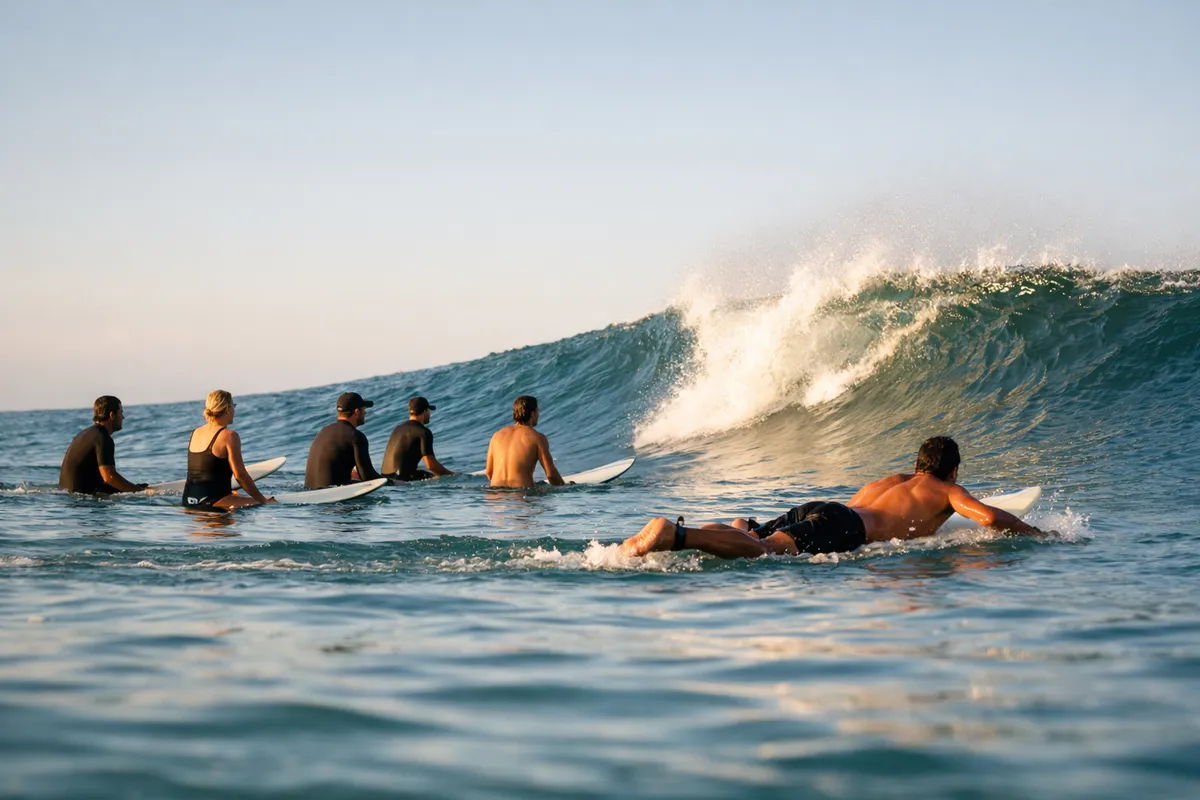
This is the single most important rule in surfing. The "peak" is the part of the wave that breaks first — the steepest, most critical section. The surfer who is closest to the peak has the right of way on that wave.
In practice:
- If two surfers paddle for the same wave, the one closer to where it's breaking goes. The other pulls back.
- If you're further from the peak and you go anyway, you've "dropped in" — the most common and most disliked violation in surfing.
At a right-hand break, the surfer furthest right (closest to the peak) has priority. At a left-hand break, the surfer furthest left has priority. At an A-frame (breaks both ways), one surfer can go left and one can go right.
Rule 2: Don't drop in
"Dropping in" means taking off on a wave that someone else is already riding. They're on the wave, going along the face, and you paddle in and take off in front of them — cutting them off.
This is the biggest sin in surfing. It's dangerous (collisions happen), disrespectful (you stole their wave), and universally condemned.
How to avoid it:
- Before you paddle for a wave, look both ways. Is someone already on it? Is someone closer to the peak about to take off? If yes, don't go.
- If you're already paddling and realize someone has priority, pull back. Straighten your board toward shore or kick out the back. Don't commit.
- If you accidentally drop in, pull off the wave immediately and apologize. Mistakes happen. Owning them matters.
Rule 3: The paddler yields to the rider
When you're paddling out and a surfer is riding a wave toward you, you need to get out of their way — not the other way around.
How to handle it:
- Paddle toward the whitewater, not the open face. If a surfer is riding along the green face, paddle behind them into the broken section. It's rougher for you, but it keeps their path clear.
- Never paddle directly in front of a riding surfer. If they can't avoid you, you both get hurt.
- If you can't get out of the way, stop and stay still. A predictable obstacle is easier to avoid than a moving one.
This feels counterintuitive — why paddle into the whitewater? — but it's the universal protocol. The rider has momentum and limited ability to change direction. You're the one who needs to move.
Rule 4: Don't snake
"Snaking" means paddling around someone to get closer to the peak and steal priority. Technically you're now "closest to the peak" — but everyone saw what you did.
Example: You and another surfer are both sitting in the lineup. A wave comes. They start paddling. You quickly paddle further inside (closer to the peak) and take off, claiming priority because you're now deeper.
This is the drop-in's sneaky cousin. It's legal in the narrowest technical sense and universally despised. Don't do it.
Rule 5: Don't hog the waves
In a crowded lineup, take your wave, ride it, paddle back, and wait your turn. Don't paddle straight back to the peak and take the next wave. Don't catch 5 waves in a row while others wait.
Informal rotation varies by spot, but the general principle is: everyone gets waves. If you're on a longboard or foamie (which catches waves easier than a shortboard), be especially conscious of giving others turns.
Rule 6: Hold onto your board
Your board is a projectile. A loose surfboard in a crowded lineup is dangerous. When a wave hits you:
- Don't just bail and let the board go. Turtle roll (on a longboard) or duck dive (on a shortboard) to keep the board under control.
- If you do lose your board, warn people. Shout "Board!" so anyone behind you can protect themselves.
- Wear your leash. Always. Every session. No exceptions.
Rule 7: Respect the locals
Every beach has regulars who surf there daily. They know the wave, the currents, the rocks, and each other. As a visitor:
- Be humble. Don't paddle straight to the peak and compete with locals for the best waves.
- Wait your turn. Sit slightly to the side at first. Take waves that others don't want. As the session goes on and people see you're respectful, you'll naturally get more waves.
- Say hello. A simple nod or "hey" when you paddle out goes further than you'd think.
- Don't bring a crew. Three friends all paddling aggressively at a spot where regulars surf is a recipe for conflict.
Rule 8: Communicate
If you're not sure who has priority, call out. "Going left!" or "Going right!" tells other surfers your intention. If someone calls their direction and you're in the way, yield.
If you make a mistake — drop in, get in someone's way, lose your board — apologize. A simple "Sorry, my bad" defuses almost every situation. Pretending it didn't happen or arguing about it makes everything worse.
Beginner-specific etiquette
As a beginner, you get some grace — experienced surfers know you're learning. But that grace runs out if you:
- Repeatedly drop in after being told not to
- Paddle out into an advanced lineup you can't handle
- Let your board fly loose into the crowd
- Sit on the peak and waste waves you can't catch (paddle for everything, miss everything, block others from catching them)
The best thing you can do as a beginner: surf beginner beaches, surf the shoulder (not the peak), and be aware of everyone around you. You won't be perfect. Nobody expects you to be. But awareness and respect go a long way.
What happens if you break the rules
Usually: someone will tell you. This might be a polite correction ("Hey, I was on that wave") or a frustrated shout ("Don't drop in!"). Either way:
- Don't argue. Acknowledge it.
- Adjust your positioning so it doesn't happen again.
- If the situation feels hostile, move to a less crowded section of the beach.
Actual physical confrontation is extremely rare at beginner beaches. It's more common at competitive advanced spots — which is another reason to stick to beginner-appropriate lineups while you're learning.
The short version
- Closest to the peak has priority
- Don't drop in
- Paddler yields to rider
- Don't snake
- Share waves, take turns
- Hold your board
- Respect locals
- Communicate and apologize when you mess up
Master these and you'll be welcome in any lineup.