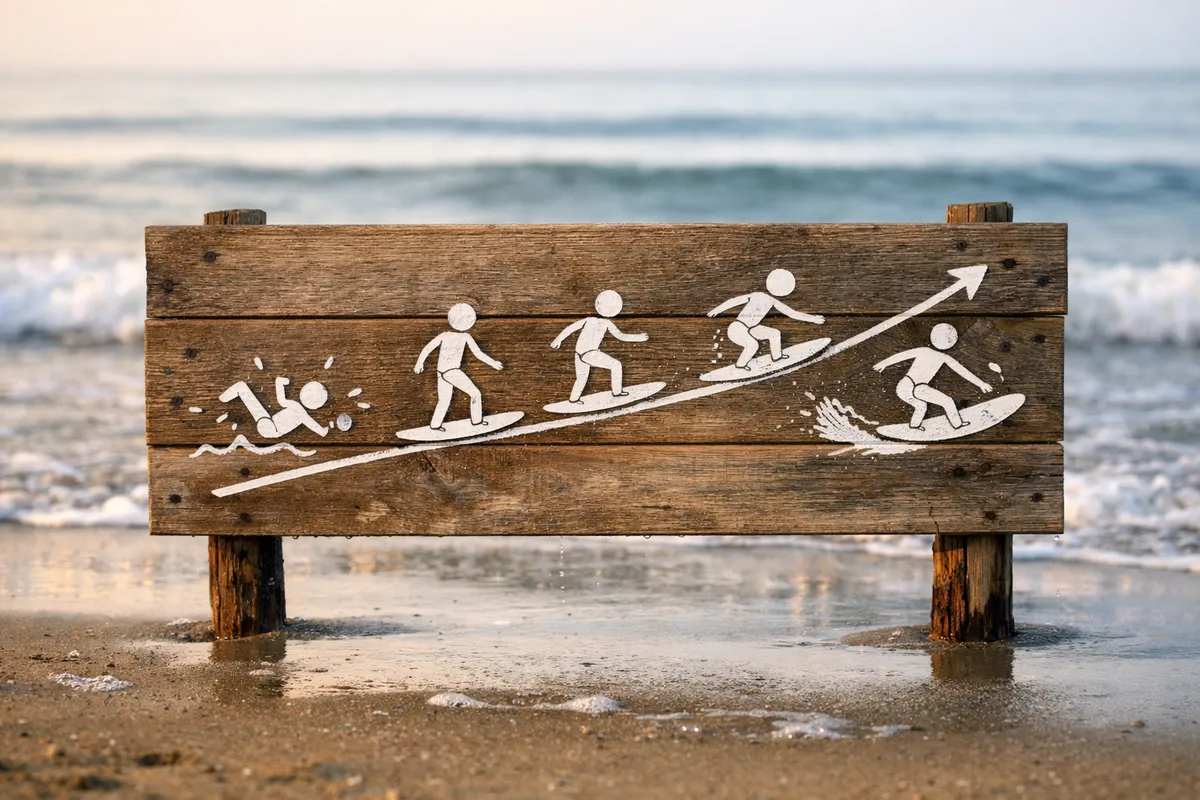
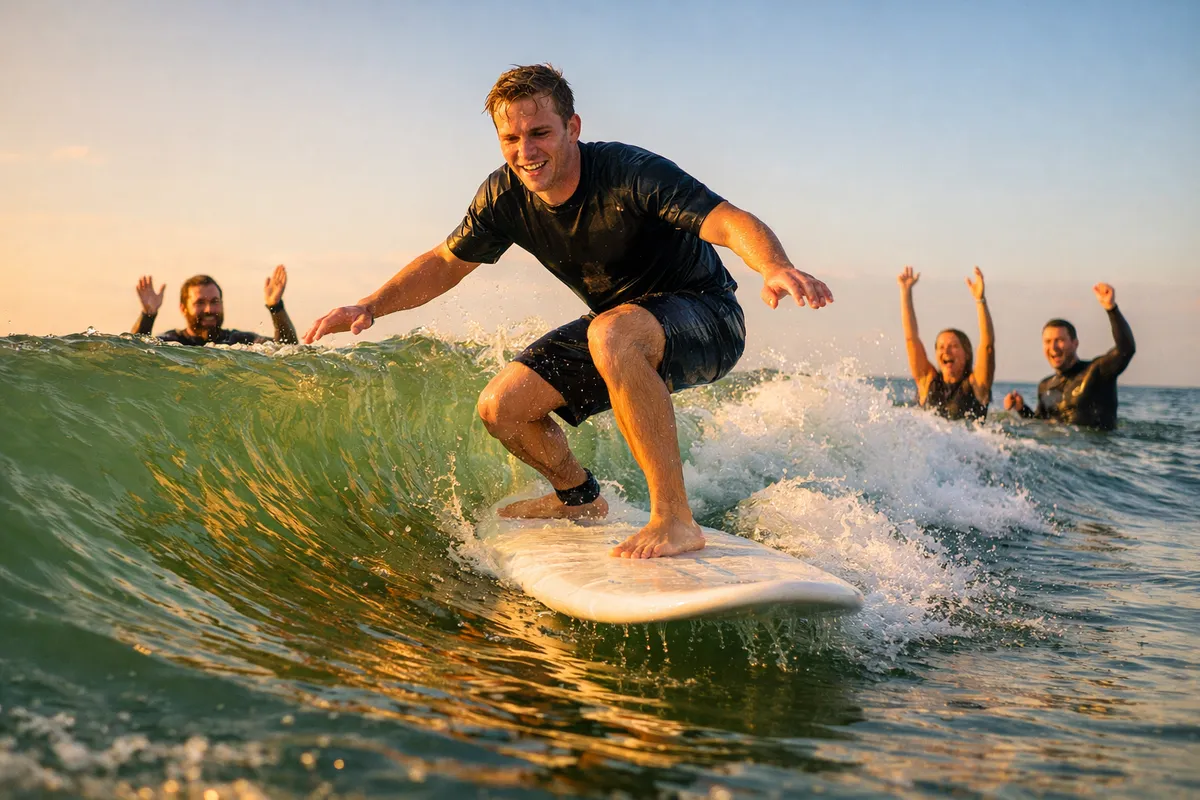
There's a moment in every surfer's life that divides before and after. It's not the first time you stand up in whitewater — that's exciting but mechanical. It's the first time you catch an unbroken wave: you see the wall of water rising behind you, you paddle, the wave picks you up, and you drop down the face with the whole ocean opening in front of you.
It lasts maybe four seconds. You remember it forever.
Getting there requires everything you've already learned — paddling, popping up, reading waves — plus a few new skills specific to catching waves before they break. Here's how it works.
What's different about unbroken waves
In the whitewater zone, the wave has already broken. It's a rolling wall of foam that pushes you forward regardless of your positioning. You just had to be in front of it.
An unbroken ("green") wave is still standing up. It hasn't broken yet. To catch it, you need to:
- Be in the right position — sitting at the right depth, in the wave's path
- Start paddling at the right time — too early and you tire out, too late and the wave passes under you
- Match the wave's speed — the wave needs to pick you up, which only happens when your paddling speed is close to the wave's speed
- Pop up at the right moment — as the wave lifts you and you feel the acceleration, not before
Step 1: Find your position in the lineup
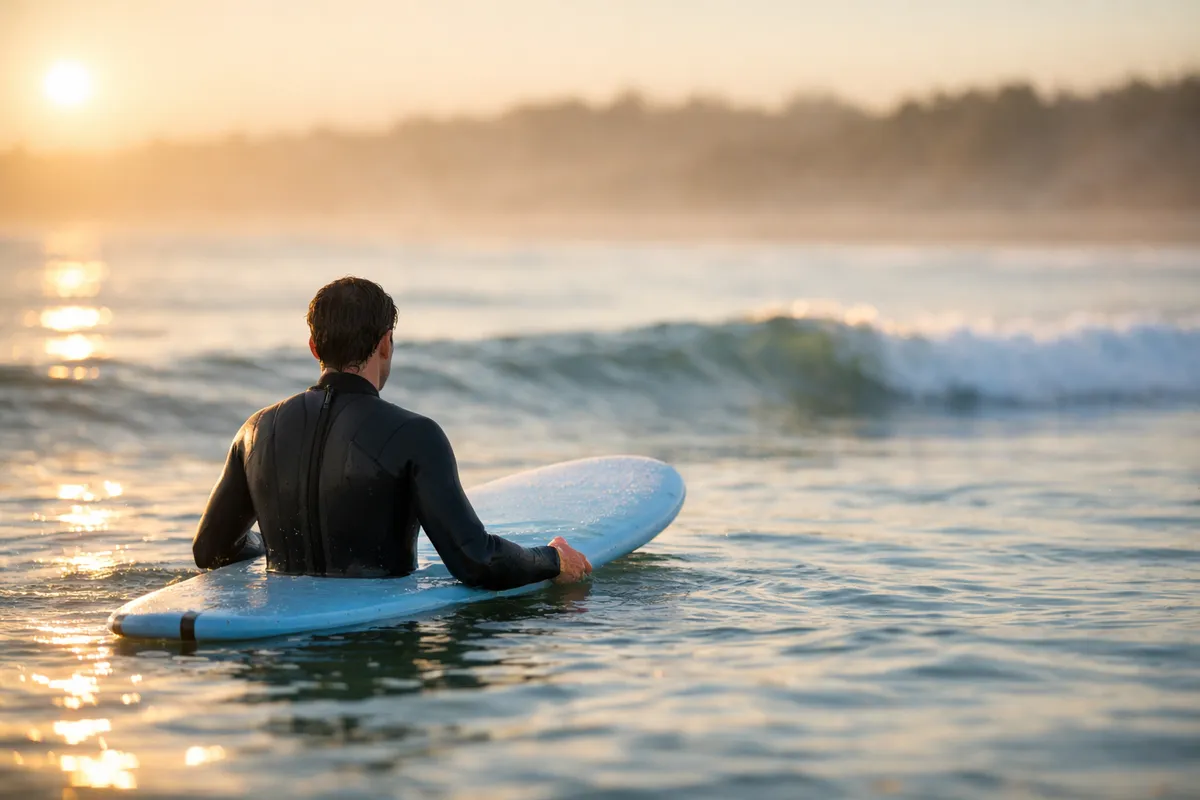
The "lineup" is the area just outside where waves consistently break. This is where you sit and wait for waves.
How to find it
- Watch other surfers. Where are they sitting? That's the lineup.
- Watch the waves. Waves start to stand up (steepen) about 10–20 meters before they break. You want to be right at the point where they're starting to stand up.
- Use a landmark. Line yourself up with something on the beach — a building, a lifeguard tower, a tree. This prevents drifting without noticing.
If you're too far out, waves pass under you without breaking. Too far in, waves break on top of you. The sweet spot is where the wave is steep enough to push you but hasn't started breaking yet.
Step 2: Choose your wave
Not every wave is worth paddling for. As a beginner catching green waves for the first time, look for:
- Smaller waves in the set. The first or second wave, not the biggest one.
- Waves that haven't peaked yet. A wave that's already vertical and about to pitch is too late — you'll get caught in the lip.
- Waves with a gentle slope. You want a wave that's standing up gradually, giving you time to match its speed.
Let the first few sets pass while you watch. Notice where each wave starts to break, how fast it moves, and which ones look manageable. Experienced surfers do this unconsciously. You need to do it deliberately for now.
Step 3: Turn and paddle
When you see your wave approaching (about 10–15 seconds away), turn your board to face the shore and start paddling.
The critical details
- Start early. Begin paddling when the wave is about 5–8 meters behind you. Most beginners start too late.
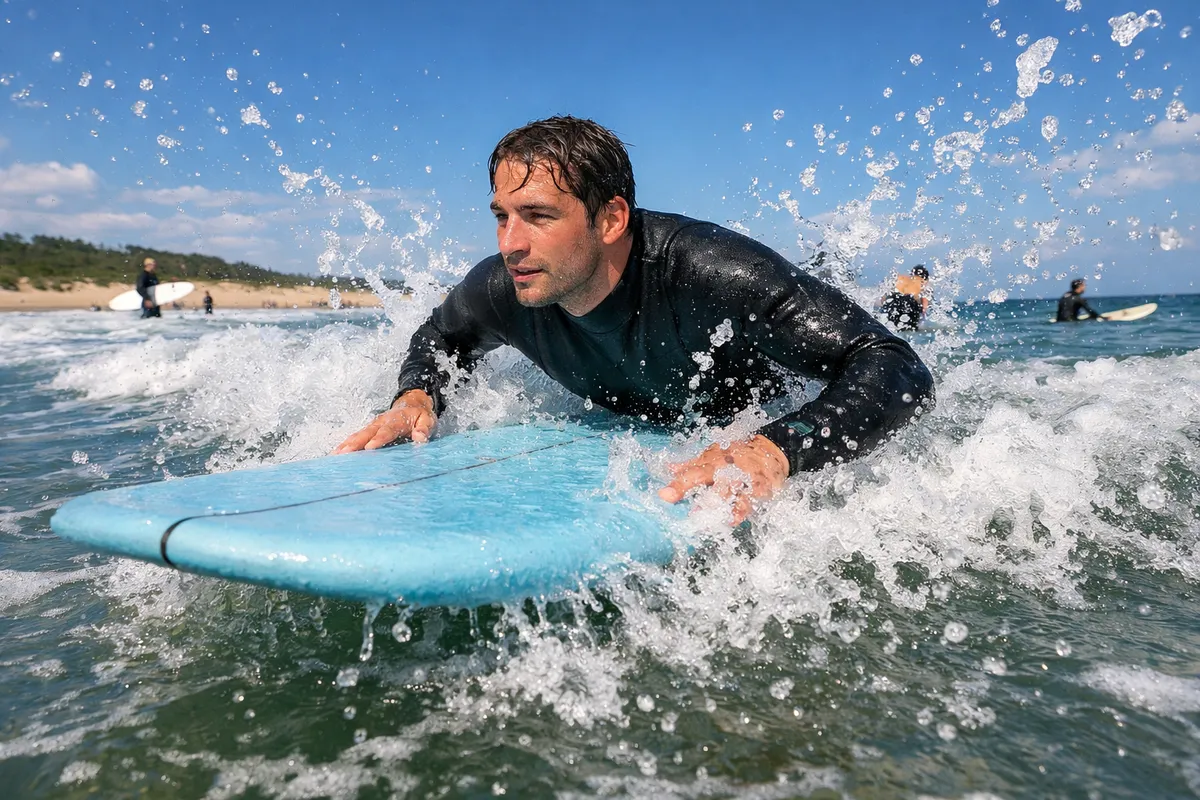
- Paddle hard. This isn't a cruise — you need speed. Use deep, powerful strokes. Pull water from in front of your head all the way to your hip.
- Keep your body centered on the board. Too far forward and you'll nose-dive ("pearl"). Too far back and the wave won't pick you up.
- Look forward, not over your shoulder. Glancing back once to time the wave is fine. Constantly looking back kills your paddle speed and shifts your weight.
Step 4: Feel the catch
There's a distinct moment when the wave catches you. You'll feel:
- Acceleration. You suddenly speed up without paddling harder.
- Lift. The tail of your board rises as the wave passes under you.
- The drop. Your board angles downward as you slide down the wave face.
This is the moment. Two or three more paddle strokes to confirm you're locked in, then pop up.
Step 5: Pop up (with adjustments)
The pop-up on a green wave is the same motion as in whitewater, with two differences:
- You're angled. The board is tilting forward down the wave face. Your front foot needs to land slightly further back than in whitewater to prevent nose-diving.
- You need to look where you're going. In whitewater, you ride straight to shore. On a green wave, you'll angle along the face — look left or right along the wave, and your body will follow.
The most common mistake
Popping up too early. If you stand before the wave has caught you, you lose all momentum and the wave passes under you. Wait for the acceleration. Wait for the lift. Then stand.
The second most common mistake: looking down at the board. Your body goes where your eyes go. Look at the water ahead of you — the section of wave you want to ride — not at your feet.
What "catching" vs "not catching" feels like
When it doesn't work
The wave rises under you and then passes through. You feel a brief lift, then it's gone. You're still sitting there. The wave broke 5 meters in front of you and you weren't on it.
This almost always means one of three things:
- Not enough paddle speed. You weren't moving fast enough for the wave to pick you up. Paddle harder, start earlier.
- Too far out. The wave wasn't steep enough where you were sitting. Move 3–5 meters closer to shore.
- Weight too far back. Shift your body slightly forward on the board (half an inch makes a difference) to help the nose engage with the wave.
When it works
The wave lifts you. You accelerate. The board tilts forward. You feel yourself sliding downhill on water. You pop up. You're standing on a moving wave with the entire beach in front of you.
The first time it works, you'll be grinning so hard you can't close your mouth. This is the feeling that turns people into surfers.
After the catch — riding the wave
Once you're standing on a green wave, you have options you never had in whitewater:
- Angle along the face. Instead of riding straight to shore, turn your shoulders and look along the wave. The board will follow. This is the beginning of real surfing — generating speed by riding along the wave face.
- Trim. Subtle weight shifts forward (speed up) and back (slow down). You're not just standing anymore — you're driving.
- Kick out. When the wave closes out or you want to exit, lean back and turn toward the horizon. The wave passes under you and you're safely back in the water.
Don't try to do all of this on your first green wave. Just ride it. The rest comes naturally with repetition.
How many sessions until you get there?
Most beginners catch their first unbroken wave somewhere between session 5 and session 15. It depends on wave conditions, board size, and how often you practice. Consistent small waves (waist-high, gentle slope) make it easier. Bigger or steeper waves are harder to time.
If you're at session 20 and still can't catch green waves, consider a private lesson focused specifically on this skill. An instructor in the water can position you, tell you exactly when to paddle, and give real-time feedback. One good private session often unlocks it.
Where to practice
The best spots for first green waves are mellow point breaks and gentle beach breaks where the waves stand up slowly before breaking:
- Waikiki (Hawaii) — the textbook gentle green wave
- The Pass (Byron Bay) — long, slow right-hander
- Batu Bolong (Bali) — the outside section has gentle green waves
- Imsouane Bay (Morocco) — one of the longest, gentlest rides in the world
On Surfyx, use the spot map to find beginner spots with green-wave potential. Every listed surf school can help you make the whitewater-to-green-wave transition.