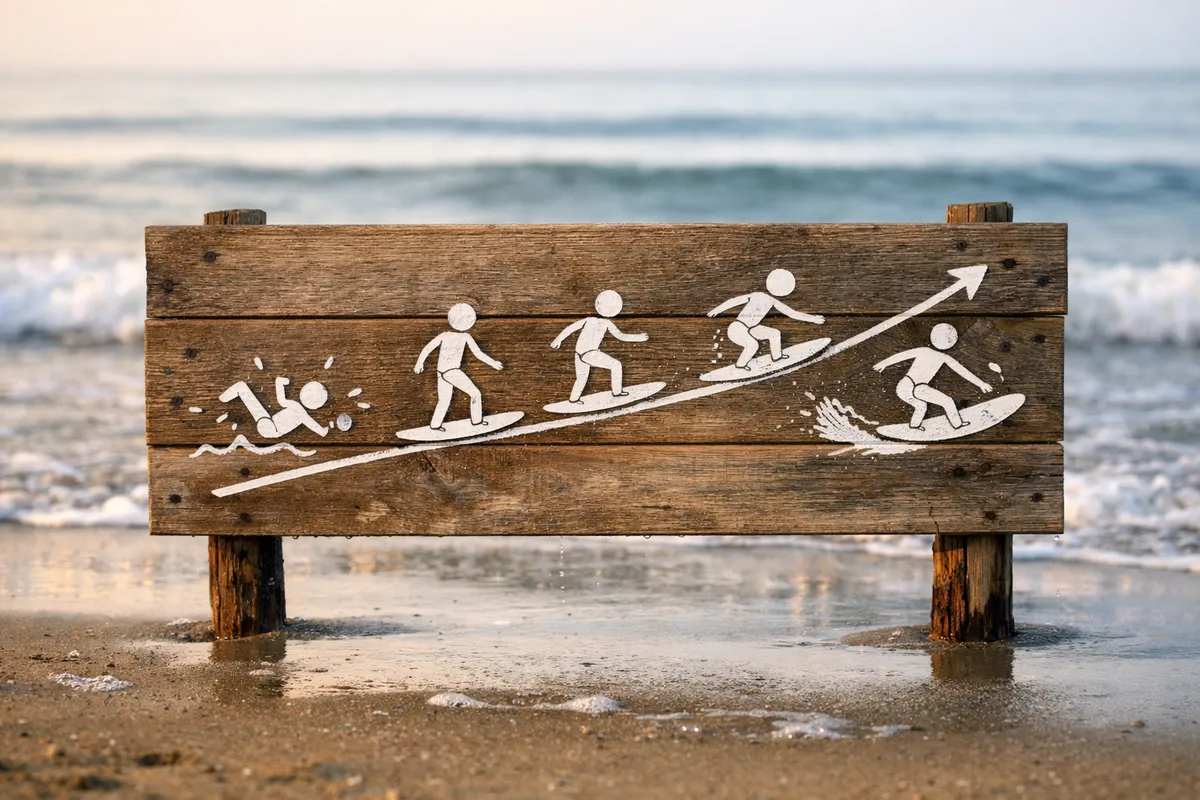
You can pop up perfectly on the sand. You've caught whitewater in waist-deep water. You feel ready. Then you try to paddle out past the break — and the ocean pushes you back to shore over and over until you're exhausted.
Welcome to the real beginner bottleneck. Paddling out through whitewater is the first skill that separates "I took a lesson" from "I can actually surf." It's not about strength or fitness — it's about technique and timing.
Why it's hard
Broken waves (whitewater) carry enormous energy. A knee-high wall of whitewater hitting a 9-foot foam board is like a sail catching wind — it pushes you straight back to the beach. Beginners instinctively fight it with brute-force paddling, which exhausts them before they even reach the lineup.
The solution is a combination of three things: technique (how you handle your board when waves hit), timing (when you paddle), and positioning (where you paddle).
Technique 1: The turtle roll (for longboards and foamies)
If you're riding anything over 7 feet (which you should be as a beginner), you can't duck dive it — the board is too buoyant. Instead, you turtle roll.
How to do it
- See the wave coming. Stop paddling. Grip the rails (sides of the board) firmly at about chest width.
- Roll the board upside down — you go under, the board goes on top of you. Pull the board tight against your body.
- Let the wave pass over you. The flat bottom of the board faces the wave and offers less resistance than the deck side.
- Roll back over once the turbulence passes. Climb back on and start paddling immediately.
Common mistakes
- Rolling too late. Start the roll 2–3 seconds before the wave hits, not as it arrives.
- Holding the board at arm's length. Keep it tight against your body — distance creates leverage for the wave to rip it away.
- Forgetting to paddle after. The window between waves is your chance. Don't waste it adjusting or resting — paddle hard.
Turtle rolls feel awkward the first few times. That's normal. Practice in calm water before you need it in real whitewater.
Technique 2: The push-through (for smaller whitewater)
For smaller, weaker whitewater (ankle to knee height), you don't need a full turtle roll. Instead:
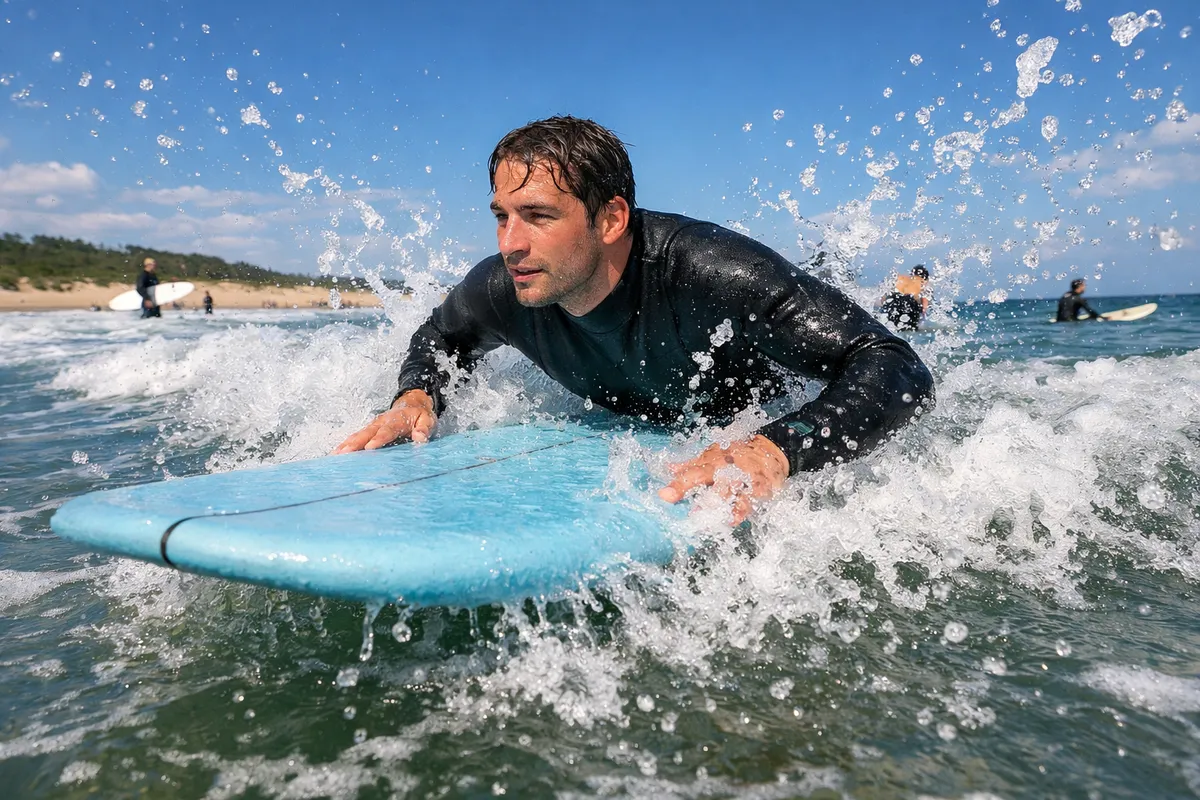
- Push up into a high cobra position (arms straight, chest off the board).
- Let the whitewater pass under your chest and over the board.
- Drop back down and paddle.
This works because lifting your body weight reduces the surface area the water pushes against. It only works on small whitewater — anything above knee height and you need a turtle roll.
Technique 3: The duck dive (for shortboards — later)
If you've progressed to a board under 7 feet with less volume, you can push the nose underwater and submarine under the wave. This is the standard technique for intermediate and advanced surfers.
As a beginner on a foam board, you almost certainly can't duck dive. The board is too buoyant. Don't waste energy trying — use turtle rolls instead.
Timing: the most underrated skill
Waves come in sets — groups of 3–7 waves with lulls (gaps) between them. The lull is when you make your move.
How to time it
- Before entering the water, sit on the beach for 5 minutes and watch. Count the waves in each set. Note the gap between sets. Most spots have a rhythm — 4 waves, 30-second lull, 4 more waves.
- Start paddling at the beginning of a lull. Don't rush into the water randomly.
- Paddle hard during the lull. This is your window. Sprint paddling for 30 seconds during a lull gains more ground than 5 minutes of fighting through sets.
- When the next set arrives, stop and turtle roll. Don't try to outpace a wave — you won't.
Experienced surfers make paddling out look effortless because they time it perfectly. They're not stronger than you — they're waiting for the right moment.
Positioning: don't paddle through the impact zone
The "impact zone" is where the waves break — the most turbulent, powerful part of the water. Paddling straight through it is the hardest possible route.
Instead:
- Paddle to the side. Look for a channel — a deeper section where waves don't break as hard. Channels are often visible as calmer, darker water between breaking sections.
- If there's no channel, angle your paddle-out. Go diagonally rather than straight out. You'll travel further but encounter less direct whitewater force.
- Use rip currents (carefully). Rips flow outward from shore — they'll carry you past the break. Only do this if your instructor has shown you the rips and you're comfortable. Never fight a rip; ride it out and paddle sideways to escape.
The real-world sequence
Putting it all together on a typical paddle-out:
- Watch from the beach. Identify the set pattern and any channels.
- Enter the water during a lull. Wade out until you're waist-deep, then lie on your board and start paddling.
- Paddle hard through the shallow whitewater zone. Push-throughs work here — the whitewater is small.
- When a real set wave hits, turtle roll. Wait for it to pass. Roll back over. Paddle immediately.
- Repeat. Each turtle roll loses you some ground, but each paddle burst between waves gains you more. Net progress is outward.
- Reach the lineup. You're past where the waves break consistently. Sit up on your board, catch your breath, and orient yourself.
How to build paddle fitness
If you're getting exhausted before reaching the lineup, the issue is usually technique (inefficient paddling stroke or poor timing), not fitness. But building paddle endurance helps:
- Swimming. Freestyle swimming is the closest dryland equivalent. 20–30 minutes, 3x/week.
- Practice paddling in flat water. Paddle your board in calm conditions to build muscle memory without the stress of waves.
- Upper body mobility. Shoulder flexibility matters more than raw strength. Yoga and stretching help.
When to stay inside
If the waves are consistently over your head and you can't make progress after 10 minutes of trying, the conditions are too big for your current skill level. There's no shame in surfing the whitewater zone instead — you'll still improve, and you'll avoid the exhaustion and discouragement of an impossible paddle-out.
Ask your instructor: "Is it small enough for me to paddle out today?" A good instructor will give you an honest answer.
Where to practice
On Surfyx, use the spot map to find beginner beaches with gentle whitewater and channel access. Every listed surf school teaches paddle-out technique as part of the progression curriculum.
Next step
Once you can paddle out consistently, you're ready to catch your first unbroken (green) wave — the moment everything changes. Read catching your first unbroken wave.