The internet is full of "surf fitness" programs selling balance boards, resistance bands, and 12-week gym plans that promise to make you a better surfer. Most of them are overengineered.
Here's the truth: the best training for surfing is surfing. But if you can't get in the water every day (most beginners can't), there are a handful of exercises that directly transfer to what your body does on a wave. No equipment needed. No gym membership. Just your body and 20–30 minutes, 3 times a week.
The three things surfing demands
- Paddle endurance — you paddle more than you surf. Your shoulders, upper back, and arms need to work for extended periods without burning out.
- Pop-up explosiveness — the pop-up is a fast push-up-to-squat transition. It requires upper body strength and hip mobility, performed in a split second.
- Balance and core stability — standing on a moving surface requires constant micro-adjustments from your core, hips, and ankles.
Paddle endurance
Swimming (the single best exercise)
Nothing mimics paddling like swimming. Freestyle (front crawl) uses the same muscle groups: shoulders, lats, triceps, and upper back.
- Frequency: 2–3x per week
- Duration: 20–30 minutes per session
- Intensity: Moderate and sustained, not sprint intervals. You're building endurance, not speed.
If you have access to a pool, swim. If you have access to open water, even better — ocean swimming adds the element of dealing with current and chop.
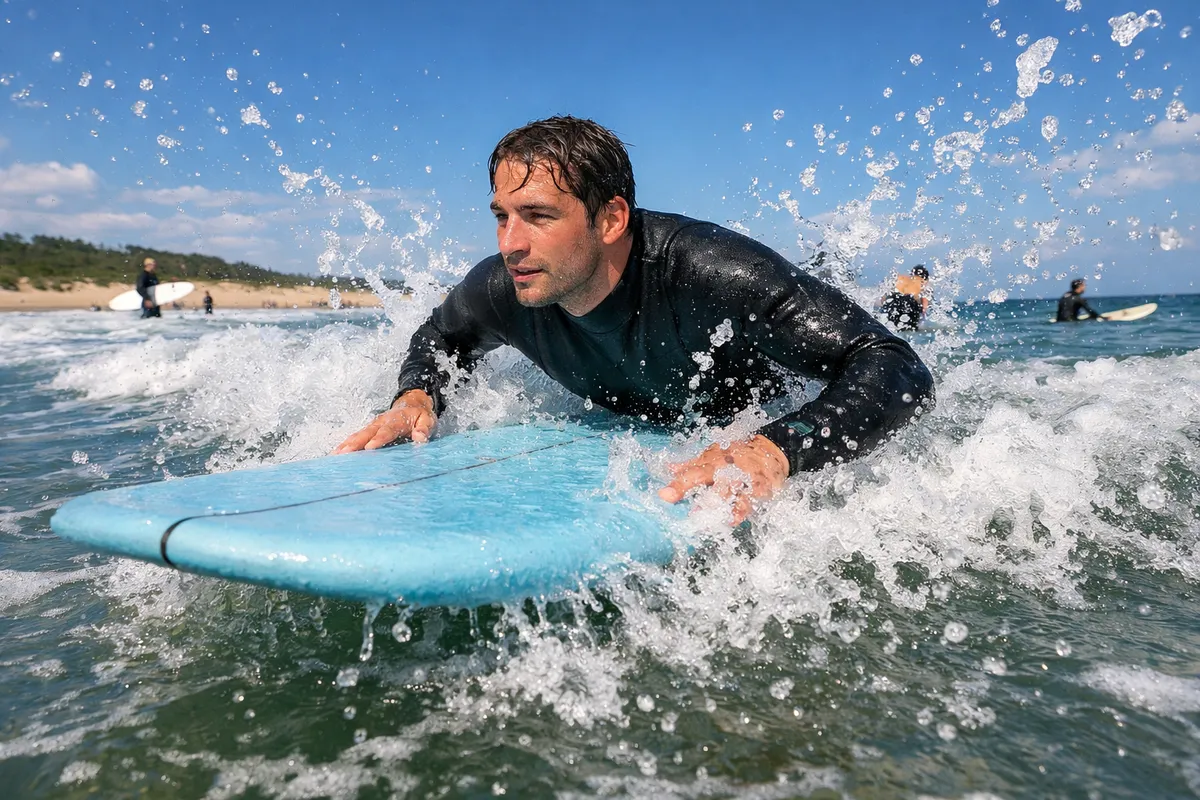
Prone paddling (on a board)
If you have a board and access to flat water (a lake, a calm bay), practice paddling. 20 minutes of sustained paddling builds the specific muscles and cardio better than anything else.
Resistance band pull-aparts
If you don't have water access, this is the best dry-land substitute for paddle strength:
- Hold a resistance band at chest height with both hands, arms extended.
- Pull the band apart by squeezing your shoulder blades together.
- 3 sets of 15–20 reps.
Targets the mid-back muscles (rhomboids, rear deltoids) that fatigue first during paddling.
Pop-up strength and speed
Push-ups
The pop-up starts as a push-up. If you can't do 10 clean push-ups, you'll struggle with the pop-up in the water.
- Standard push-ups: 3 sets of 10–15. Full range of motion. Chest to ground, arms fully extended.
- Explosive push-ups: Push up fast enough that your hands briefly leave the ground. 3 sets of 5–8. This builds the speed you need for a quick pop-up.
The pop-up practice
Do the actual pop-up motion on the floor:
- Lie face down, hands at chest level (like the bottom of a push-up).
- In one explosive motion: push up, swing your feet under you, and land in a low surf stance (back foot perpendicular, front foot angled forward, knees bent).
- Stand up. Lie back down. Repeat.
- Reps: 3 sets of 8–10
- Focus: Speed and fluidity. The motion should be one continuous movement, not push-up → pause → jump.
Practice this on a yoga mat or carpet. If you have a foam board, practice on the board itself — the width changes the foot placement.
Burpees
A burpee is essentially a pop-up plus a jump. They build the same explosive push-to-stand pattern, plus cardiovascular endurance.
- 3 sets of 8–12
- Focus on the transition from floor to standing — that's the transferable part.
Balance and core stability
Single-leg exercises
Surfing happens on an unstable surface, and you're rarely perfectly balanced on both feet. Single-leg work builds the stabilizer muscles around your ankles, knees, and hips.
- Single-leg squats (to a chair): Stand on one leg, sit slowly onto a chair, stand back up. 3 sets of 8 per leg.
- Single-leg deadlifts: Stand on one leg, hinge forward at the hip, touch the ground, stand back up. 3 sets of 8 per leg. Hold a water bottle or light weight for added challenge.
Plank variations
Planks strengthen the core muscles that stabilize your body on the board.
- Standard plank: Hold for 30–60 seconds. Maintain a straight line from head to heels.
- Side plank: 30 seconds per side. Targets the obliques, which are critical for turning and balance.
- Plank with shoulder taps: From a plank position, alternate tapping opposite shoulders while keeping your hips still. 3 sets of 10 per side.
Yoga
Yoga is the best single cross-training activity for surfing. It builds flexibility, balance, core strength, and body awareness — all in one practice. Key poses for surfers:
- Downward dog — shoulders, hamstrings, calves
- Warrior I and II — hip flexors, balance, leg strength
- Low lunge — hip opening (critical for the pop-up)
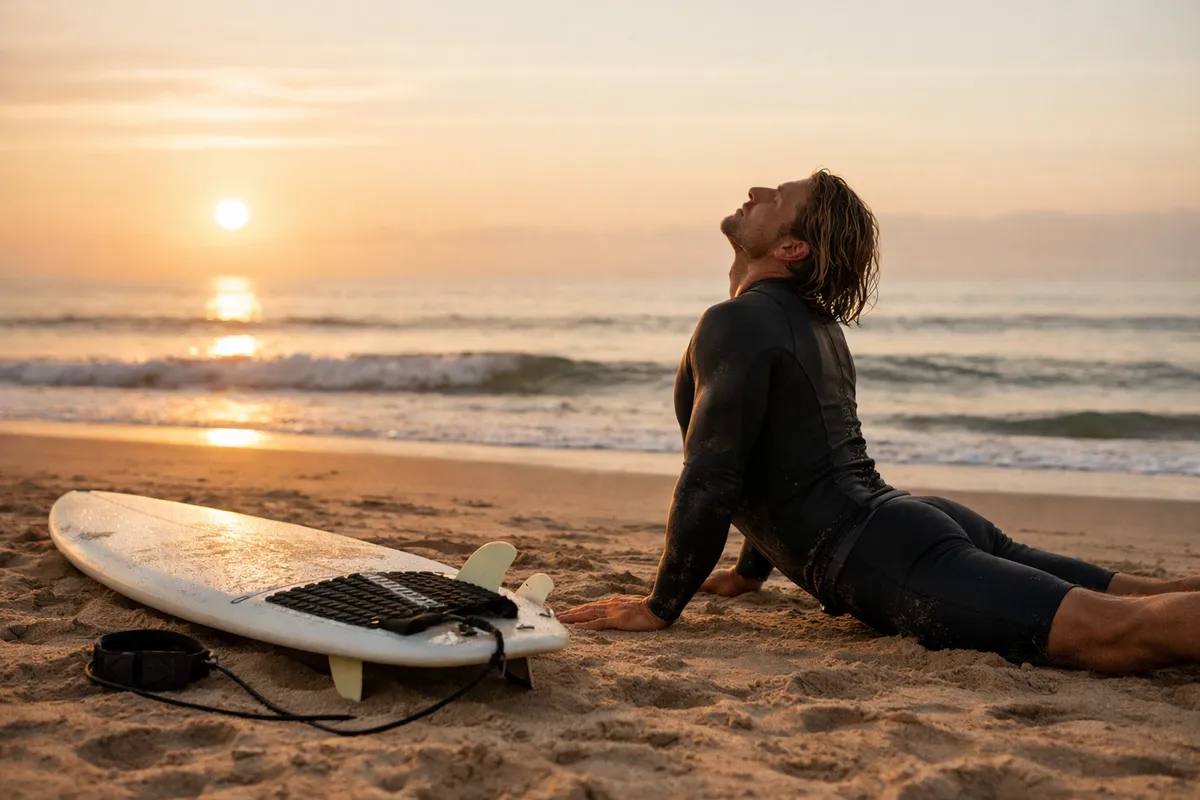
- Cobra / upward dog — spine extension (the paddling position)
- Tree pose — balance and ankle stability
A 20-minute yoga session 2–3x per week will noticeably improve your surfing. Many surf towns and camps offer yoga specifically designed for surfers.
The simple weekly routine
Three sessions per week, 20–30 minutes each:
| Day | Focus |
|---|---|
| Session 1 | Swim 20 min + push-ups (3×12) + plank (3×45s) |
| Session 2 | Pop-up practice (3×10) + single-leg squats (3×8/leg) + yoga 15 min |
| Session 3 | Swim 20 min + explosive push-ups (3×6) + side planks (3×30s/side) |
Adjust based on what you have access to. Replace swimming with resistance band work if no pool or ocean is available.
What not to bother with
- Balance boards. Fun but not necessary. Actual surfing is the best balance training for surfing.
- Heavy weight training. Strength is less important than endurance and mobility for beginners. You don't need to bench press your bodyweight to surf waist-high waves.
- "Surf training" gadgets. Paddle ergometers, surf-specific resistance tools, etc. They work, but they're expensive solutions to a problem that swimming and push-ups solve for free.
- Long-distance running. Cardiovascular fitness helps, but surfing demands upper-body endurance more than leg endurance. Swimming transfers better.
The real priority
If you can only do one thing: swim. If you can do two things: swim and practice pop-ups. If you can do three things: swim, practice pop-ups, and do yoga.
Everything else is bonus. The goal isn't to become an athlete — it's to have enough fitness that your body doesn't limit your learning when you're in the water.