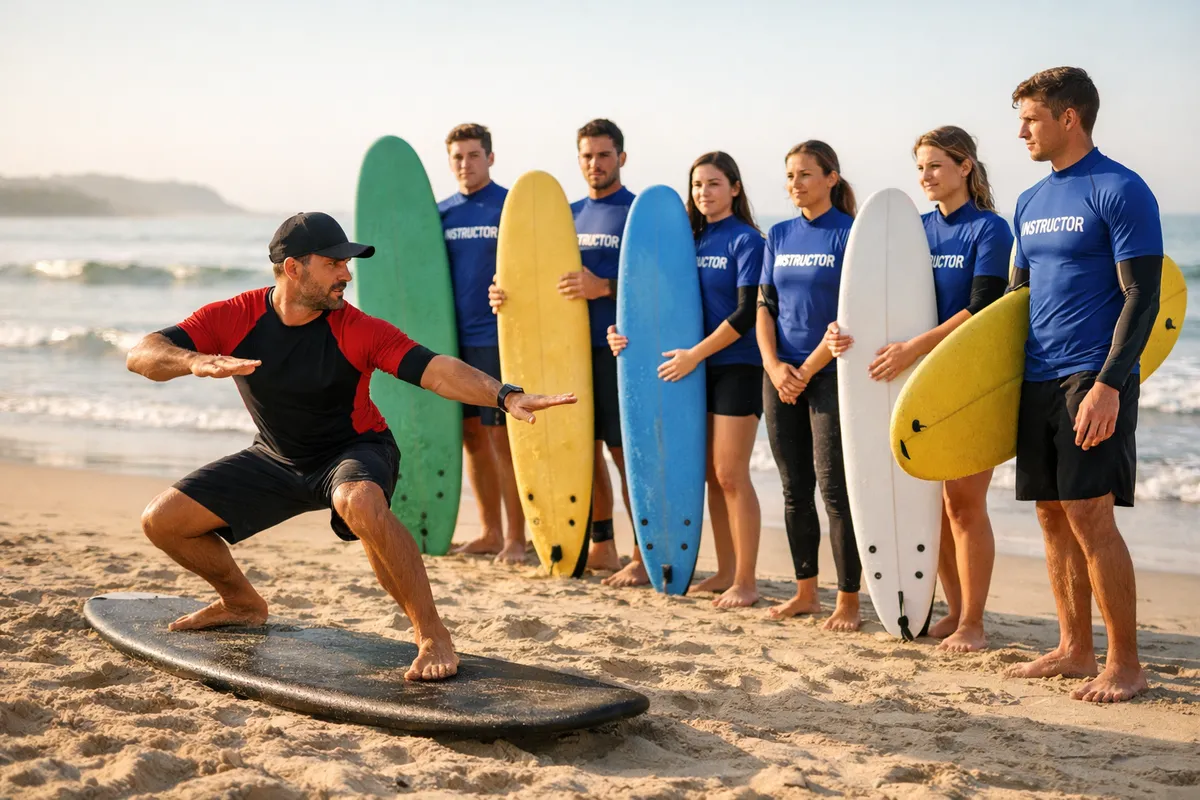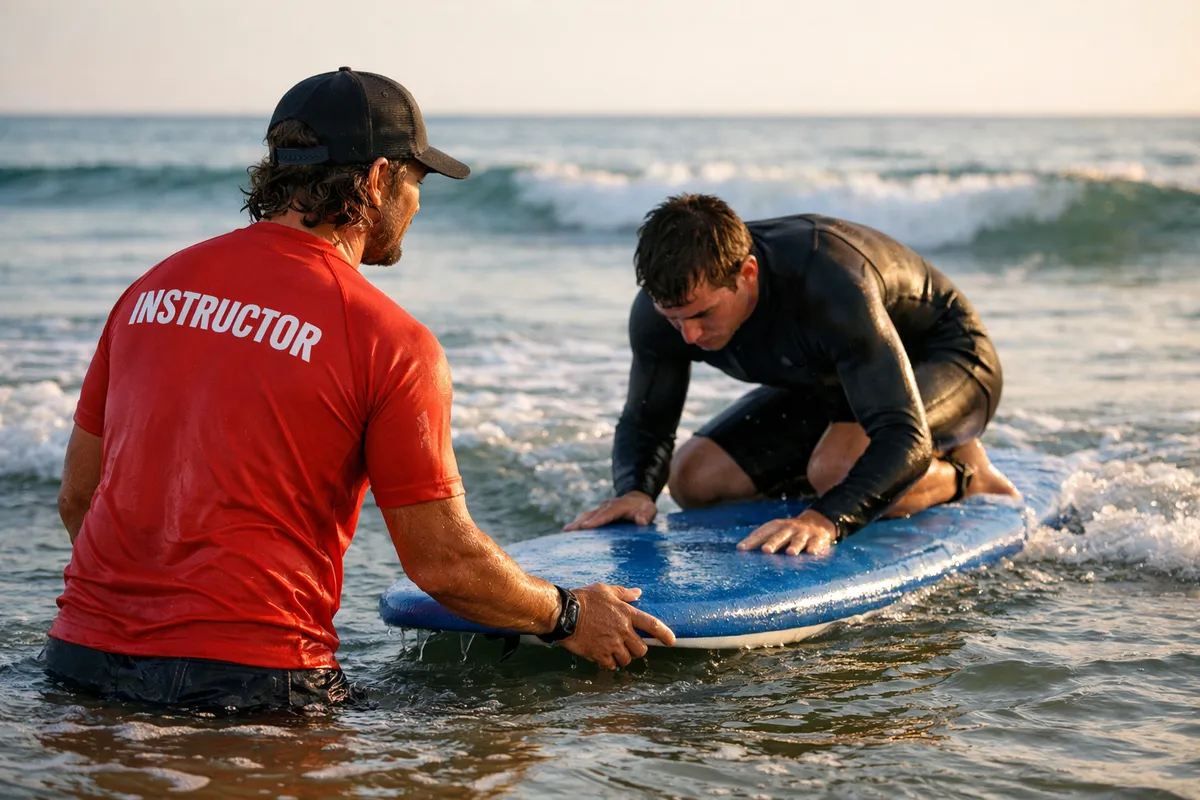
A surf instructor's job starts long before the student touches the water. The right preparation — physical tools, safety gear, and teaching skills — is what makes the difference between a forgettable lesson and one that turns someone into a surfer.
Whether you're a new instructor building your kit or an experienced one looking to upgrade, here's what actually matters.
Physical equipment
Boards
The most important tool in your arsenal. For teaching beginners, you need:
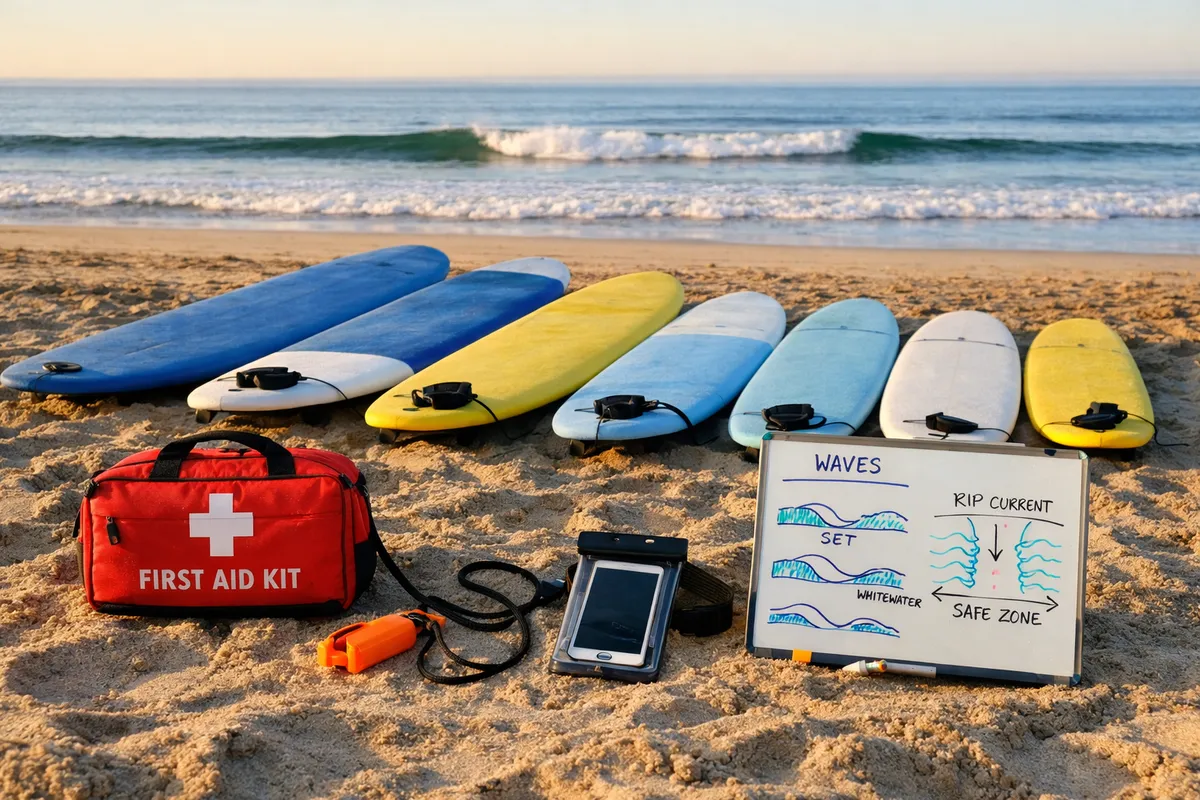
- Soft-top foam boards (8–9 ft): The default beginner board. Stable, buoyant, and safe on impact. You need at least one per student.
- Variety of sizes: A 5'6" student and a 6'2" student need different boards. Stock 7 ft, 8 ft, and 9 ft options.
- Maintained condition: Check fins (tight?), leash plugs (secure?), and deck condition (waxed?) before every session. A loose fin or broken leash mid-lesson is preventable.
Wetsuits
If you're at a cold-water spot, you need wetsuits in multiple sizes for students who don't bring their own. A range of S/M/L in both 3/2 mm and 4/3 mm covers most situations.
Safety gear
- First aid kit: Waterproof, stocked with wound dressing, antiseptic, bandages, CPR mask, and any local-specific items (sting relief for jellyfish areas). Check and restock monthly.
- Whistle: Audible signal for getting attention in the surf. Attach to your rash guard or wetsuit zipper.
- Rescue board or flotation device: For schools in areas with strong currents. A rescue board allows you to reach a student in trouble faster than swimming.
Communication tools
- Waterproof radio or walkie-talkie: For larger operations where an assistant is on the beach while you're in the water, or for communicating with lifeguards.
- Whiteboard or laminated cards: For beach-based theory. Draw wave diagrams, explain the pop-up, show the surf zone. Visual aids speed up comprehension.
Non-physical tools
Risk assessment framework
Before every lesson, run through:
- Swell and wind: Check the forecast. Is the wave appropriate for the group's level?
- Tide: What stage of the tide works best at this beach? Will it change significantly during the lesson?
- Hazards: Rip currents, rocks, marine life, other water users. What's the plan if conditions change?
- Students: Any medical conditions, injuries, fears, or limitations disclosed? Adjust accordingly.
Document this assessment. It's a professional habit that protects you legally and ensures you're thinking clearly before every session.
Lesson structure
Great instructors follow a framework but adapt it to the student:
- Beach introduction (10–15 min): safety briefing, ocean awareness, pop-up practice on sand
- Water warm-up (5 min): wade in together, get comfortable, feel the water
- Guided whitewater (30–40 min): push students into waves, coach the pop-up in real time, position and reposition
- Independent practice (15–20 min): students catch their own waves with verbal coaching from the water
- Debrief (5–10 min): what went well, what to work on, next steps
The exact timing varies by lesson length and student progress. The key: start structured, end with freedom.
Feedback skills
The best instructors give feedback that is:
- Specific: "Your back foot landed too far forward — aim for the tail pad area" vs "Good try, keep at it"
- Positive first: "Great paddle speed — now let's get that foot placement right"
- Actionable: Give one thing to focus on at a time. Three corrections after one wave overwhelms the student.
- Timed: Feedback immediately after the wave (while the student can still feel what happened) is 5x more effective than feedback at the end of the session.
Adaptability
No two students are the same. The same pop-up cue that clicks for one person confuses another. Great instructors have multiple ways to explain every concept:
- Visual (demonstrate it)
- Verbal (explain it)
- Physical (guide their body through the motion)
- Analogical ("it's like getting out of bed quickly" or "like a burpee")
Business tools
If you're freelance or running your own school:
- Booking system: Online booking with clear pricing, availability, and cancellation policy. On Surfyx, create an instructor profile to manage bookings and reviews.
- Insurance documentation: Always current, always accessible if a student or authority asks.
- Photo/video capability: A waterproof camera or phone case for session photos. Students love photos of their first wave — and it's a marketing tool.
- Review collection: After every lesson, ask for a review. Reviews build your reputation and attract new students.
Maintenance habits
- Rinse all boards and wetsuits with freshwater after every session
- Check leash cords weekly for fraying
- Repair board dings immediately (a $5 Solarez fix prevents a $50 waterlogged board)
- Restock the first aid kit monthly
- Update your certification and first aid before they expire