
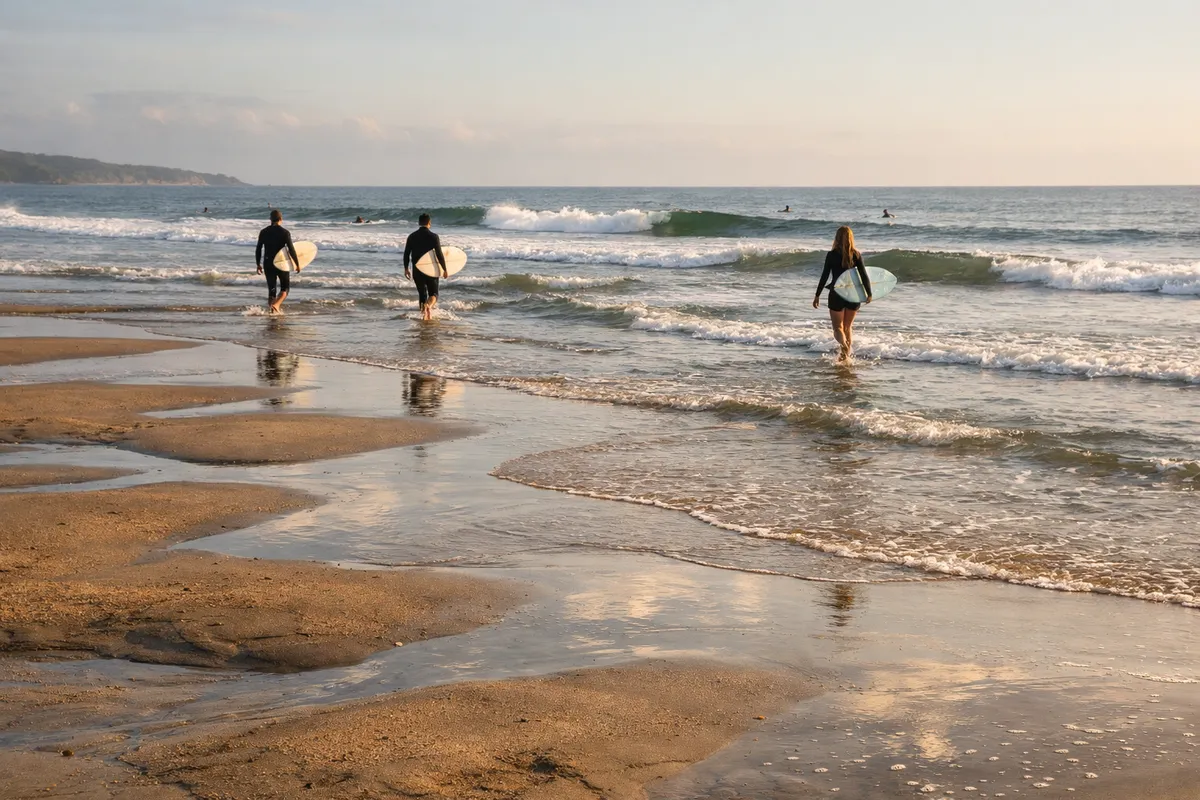
You show up at the beach at 8 AM and the waves are perfect — clean, organized, breaking evenly across the sandbar. You come back at noon and the same beach is a mushy, shapeless mess. Nothing changed about the swell or the wind. The tide changed.
Tides affect wave shape, wave power, water depth, and where waves break. Understanding them is one of the biggest upgrades you can make to your surfing — and it costs nothing but a glance at a tide chart.
What causes tides
Tides are caused by the gravitational pull of the moon (and to a lesser extent, the sun) on the earth's oceans. As the earth rotates, different parts of the ocean bulge toward the moon, creating high tides. The areas between bulges experience low tides.
Most coastlines experience two high tides and two low tides every ~24 hours and 50 minutes. The cycle shifts about 50 minutes later each day.
Tidal range
The "tidal range" is the difference between high and low tide. This varies dramatically by location:
- Small tidal range (under 1 m): Mediterranean, parts of Southeast Asia, Hawaii. Tides barely affect surfing conditions.
- Moderate tidal range (1–3 m): Most of California, Australia, West Africa. Noticeable effect on wave quality.
- Large tidal range (3–6+ m): UK, France, Portugal, parts of Canada. Tides completely transform the surf — some spots only work for 2–3 hours around the right tide.
Where you surf determines how much the tide matters. In Bali (small range), you can surf anytime. In Cornwall (large range), getting the tide wrong means no waves at all.
How each tide stage affects waves
Low tide
- Water is shallow over sandbars and reef.
- Waves break harder, faster, and more hollow.
- Beach breaks can become "dumpy" — waves that jack up and crash directly on the sand.
- Reef breaks become shallower and more dangerous.
For beginners: low tide at beach breaks is often the worst time. The waves are powerful, fast, and break in very shallow water. Falls hurt more. Exception: some deep-water beach breaks still work at low tide.
High tide
- Water is deep, covering the sandbars.
- Waves can lose their shape — they have nothing to break over, so they become slow and mushy.
- Some beach breaks effectively stop breaking at high tide (the water is too deep for the swell to feel the bottom).
- Shore break can increase — waves break very close to the beach.
For beginners: high tide can be frustrating. The waves are weak and disorganized. However, the whitewater zone is often gentler and more forgiving — which can actually be good for absolute first-timers.
Mid tide (the sweet spot)
- Water depth is moderate — sandbars shape the waves without making them too powerful.
- Waves break evenly and predictably.
- The best balance of shape, power, and safety for most levels.
For beginners: mid tide is almost always the best time to surf. The waves have shape, they're not too powerful, and they break in a predictable zone.
Rising vs falling
The direction of the tide also matters:
- Rising tide (incoming): Water is moving from low toward high. At many beach breaks, the rising mid tide produces the cleanest, most consistent waves of the day. The water pushes sand around, creating fresh sandbars.
- Falling tide (outgoing): Water is moving from high toward low. Conditions can get worse as the tide drops — waves become more hollow and less organized. Some spots are excellent on the dropping tide; it depends on the beach.
General rule: rising mid tide is the safest bet for beginners. But every beach is different. Ask local surfers or your instructor which tide works best.
How to read a tide chart
Tide charts show the water level throughout the day as a smooth curve. High points are high tides, low points are low tides.
What to look for:
- Find the high and low times. These are the peaks and troughs of the curve.
- Find the mid-tide window. Roughly halfway between low and high — usually a 2–3 hour window centered on the midpoint.
- Note the tidal range. A bigger range means the tide changes faster and conditions shift more dramatically.
Tide charts are available for free on any surf forecast app (Surfline, MSW, Windguru), tide-specific apps (Tides Near Me, My Tide Times), or your local port authority website.
Tides at different types of breaks
Beach breaks
Most affected by tides because the bottom is sand — the depth changes significantly as water levels shift. Best at mid tide in most cases. Some beach breaks have a very narrow window (1–2 hours around mid tide) where they work well.
Point breaks
Less affected by tides because the rocky point creates a consistent breaking zone. Many point breaks work across all tides, though the character of the wave changes (more hollow at low tide, more forgiving at high tide).
Reef breaks
Tides are critical at reef breaks. Too low and the reef is exposed — dangerous and unrideable. Too high and the wave may not break. Many reef breaks have a very specific tide window. Always ask locals.
Spring tides vs neap tides
The tidal range itself changes through the month:
- Spring tides (around full moon and new moon): Largest tidal range. Higher highs, lower lows. More dramatic changes throughout the day.
- Neap tides (around quarter moons): Smallest tidal range. Conditions change less throughout the day. Often more consistent for surfing.
For beginners, neap tides are slightly easier to plan around — the conditions don't shift as dramatically, and the surf window is longer.
The practical takeaway
- Check the tide chart before every session.
- Plan to be in the water during the mid-tide window (especially rising mid tide).
- If conditions suddenly change — waves go flat, or get much bigger and hollower — the tide probably shifted. Check the chart.
- Ask locals or your instructor: "What tide does this beach work best on?" Every spot has a preference.