Every "best surf spots" list on the internet is written for the wrong person. It's a list of famous spots — Pipeline, Uluwatu, Jeffreys Bay, Mavericks — places you'd kill yourself trying to learn at.
This list is different. Every spot below is chosen for three things: forgiving waves (small, slow, sand-bottomed), reliable conditions (surfable most days you show up), and real infrastructure (surf schools, rentals, and beginner-friendly lineup etiquette). If you're learning, these are the places you can show up at, book a lesson, rent a board, and be standing on a wave within the hour.
Organized by region. Within each region, the spots are ordered roughly by beginner friendliness and accessibility, not by "prestige".
Europe
1. Peniche, Portugal
Baleal beach on the northeast side of the Peniche peninsula is one of the most forgiving beginner spots in Europe. Shallow sand-bottom beach break, multiple surf schools sharing the same mellow sandbar, and near-year-round waves because Peniche catches swells from multiple directions. Best months: April to October. Water: cool (14–19°C). Need a wetsuit in most months.
2. Ericeira, Portugal
World Surfing Reserve — but also has one of Europe's best beginner beaches at Praia do Matadouro and Foz do Lizandro. Slightly more advanced than Peniche, slightly less crowded, and the village itself is one of the most pleasant small surf towns on the continent. Same water and season as Peniche.
3. Anglet / Seignosse, France
Southwestern French Atlantic coast. Long beach break that stretches for miles, with countless surf schools and rental shops along the sand. Best for beginners in June–September when the summer swells are manageable; autumn gets bigger. Water is cool most of the year.
4. Tynemouth / Cornwall, UK
Fistral and Watergate in Newquay are the classic UK beginner beaches. Wide sandy bays, surf schools everywhere, and long gentle whitewater rollers that let you practice standing up for hours. Cold water year-round (9–15°C) — you need a 4/3 mm suit minimum. Best months: June–September for smaller, friendlier waves.
5. San Sebastián / Zarautz, Spain
The Basque Country's beginner capital. Zarautz is a 2 km beach of consistent beach break with a line of surf schools. La Zurriola in San Sebastián city itself is another great urban beginner spot. Best: April–October. Water: 14–20°C.
North Africa
6. Taghazout, Morocco
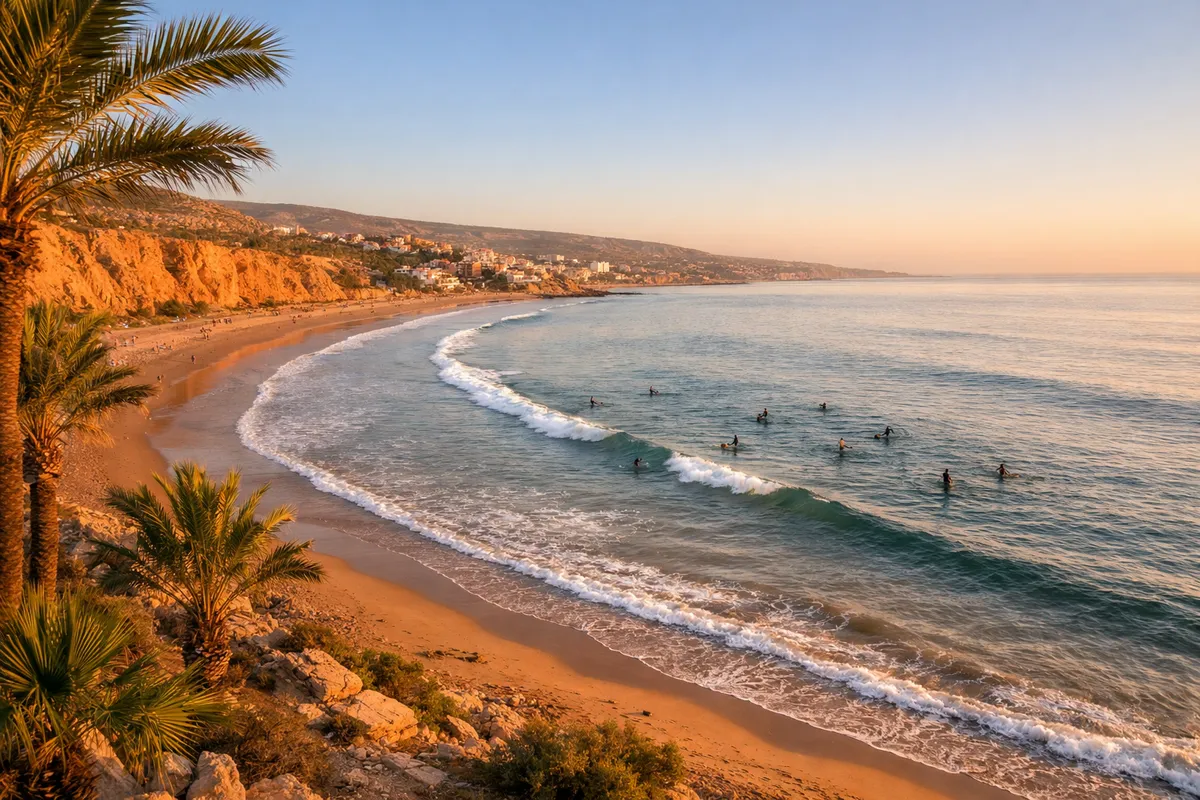
Panorama and Devil's Rock are the main beginner zones. Taghazout is a full surf village — dozens of schools, rental shops, and cheap lesson packages. Warm water most of the year (17–22°C, 3/2 mm suit), reliable small-to-medium waves October–April. See our Morocco trip guide for details.
7. Tamraght, Morocco
A 10-minute drive north of Taghazout. Smaller, quieter, and the beaches are gentler. Tamraght Beach and Banana Beach are both excellent for first-timers. Same season as Taghazout.
8. Imsouane, Morocco
The bay at Imsouane (not the famous point break) is one of the longest, gentlest right-hand rides in the world. Foreigners travel specifically to learn here because the bay is wide, shallow, and the waves barely break. Further from the airport than Taghazout so it's quieter — great tradeoff.
Central America
9. Tamarindo, Costa Rica
The surf school capital of Central America. Wide sandy bay, consistent warm-water beginner waves, and an entire ecosystem of schools, rental shops, and surfer-friendly restaurants. Best months: December to April (dry season), but surfable year-round. Water: 26–30°C, no wetsuit needed.
10. Nosara / Playa Guiones, Costa Rica
Often considered even better than Tamarindo for beginners because the crowd is smaller and the wave more forgiving. Long consistent beach break with schools along the sand. Same warm water and conditions year-round.
11. Sayulita, Mexico
Small town north of Puerto Vallarta. Very gentle right-hand break right in the center of town. Extremely beginner-friendly and the town itself is built around surf tourism — rentals, schools, and board shops everywhere. Warm water year-round.
South America
12. Máncora, Peru
Northern Peru's small surf town. Warm water (unusual for Peru — the Humboldt Current cools most of the coast), reliable point break that peels gently enough for intermediate beginners, and an established surf school scene. Best months: November–March.
13. Florianópolis, Brazil
Santa Catarina island. Praia Mole and Joaquina are the beginner beaches. Warm water November–April, very active local surf scene, and schools on the sand in high season. Brazilian surf culture is alive here — one of the best places to learn if you want the community aspect.
North America
14. Tofino, Canada
Cox Bay and Chesterman Beach on Vancouver Island. Cold water (8–14°C, need a 5/4 mm suit), but consistent waves and a thriving beginner surf school scene. Summer conditions are the friendliest. Remote, beautiful, and not crowded compared to California.
15. Waikiki, Hawaii
Yes, the postcard. Waikiki is the most famous beginner wave in the world for a reason: long, slow, knee-to-waist-high peelers rolling over a reef bottom that's deep enough to be safe. Warm water, infinite surf schools, and you learn at the literal birthplace of modern surfing. Not cheap.
16. Pacifica, California
Just south of San Francisco. Linda Mar (Pacifica State Beach) is the region's beginner hub — wide beach, mellow whitewater, surf schools in the parking lot, and the occasional redwood tree visible behind the cliffs. Cold water year-round, need a 4/3 mm wetsuit.
17. Bolsa Chica / Huntington Beach, California
Southern California's beginner mainstays. Bolsa Chica State Beach is generally smaller and friendlier than Huntington pier, which gets more advanced fast. Schools in both. Water: 14–22°C, wetsuit needed most months.
Asia-Pacific
18. Kuta Beach, Bali, Indonesia
Bali's original beginner beach and still one of the best anywhere. Long sandy bay, reliable small waves year-round, and a school on every corner. Warm water (27–29°C) — no wetsuit. See our Bali guide for the full trip.
19. Medewi, Bali
Quieter west coast alternative. A slow left point that peels forever at manageable sizes, making it one of Asia's best places for the transition from whitewater to green waves. Less crowded than Kuta.
20. Byron Bay, Australia
The Pass and Main Beach are Byron's beginner zones. Byron is one of the most surf-saturated towns in Australia, with schools, rentals, and learn-to-surf programs on every block. Water ranges from cool (17°C in winter) to warm (24°C in summer). Year-round surfable.
How to pick your first destination
A few decisions simplify the choice:
- Budget. Morocco, Indonesia, and Central America are cheapest. Australia, Hawaii, Europe in peak season are most expensive.
- Water temperature. Warm-water destinations (Bali, Morocco, Costa Rica, Mexico, Florianópolis, Waikiki, Byron Bay summer) need no wetsuit or a thin one. Cold-water spots are more forgiving in summer months.
- Season. Check the best months for the region before booking. Morocco is great in winter but harder in summer. Portugal is the opposite.
- How you want to travel. Surf camps (all-inclusive board, lessons, accommodation, food) vs independent travel (cheaper, more freedom). Surf camps are the fastest way to get in the water on your first trip.
Where to learn at each spot
On Surfyx, use the global spot map to find any of these locations with live condition data, community reviews, and lists of nearby lessons, rentals, and surf schools. Every listed school has real reviews from past students.