
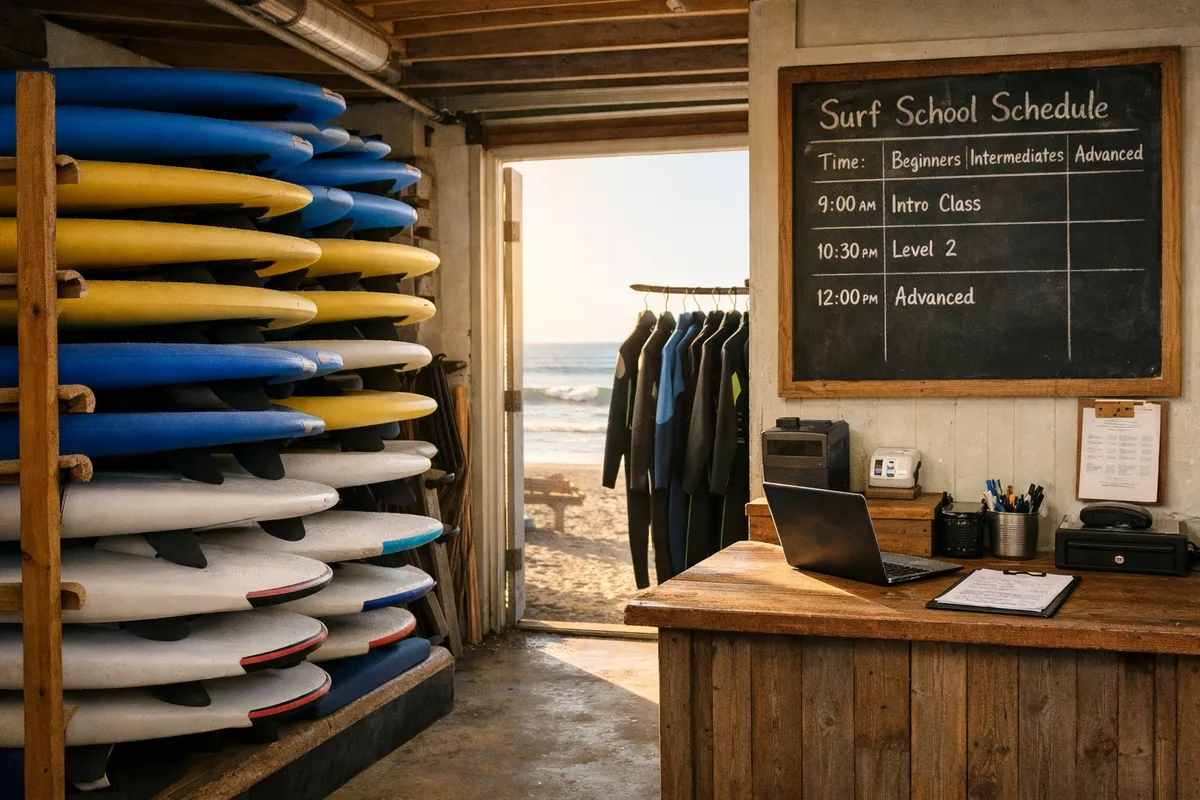
From the outside, a surf school looks like the simplest business in the world: put some boards on the beach, hire a surfer, charge tourists. But behind the charm is a real operation with permits, insurance, equipment investment, instructor management, weather dependence, and margins that would make most business owners nervous.
Understanding how surf schools work helps you choose better ones, appreciate fair pricing, and — if you're an aspiring instructor — understand the business you're joining.
The basics of running a surf school
Permits and licenses
In most countries, operating a commercial activity on a public beach requires a permit. The requirements vary wildly:
- Portugal: Municipal beach concession permit. Competitive, expensive, and limited in number.
- Australia: State-level license to operate on public beaches. Requires insurance, risk management plans, and certified instructors.
- Bali: Local business permit plus beach access arrangement with the banjar (village council).
- Costa Rica: Municipal permit plus environmental compliance in some areas.
Schools without permits are operating illegally. This matters because: no permit often means no insurance, which means no protection for you if something goes wrong.
Insurance
Legitimate surf schools carry:
- Public liability insurance — covers injury to students and bystanders
- Professional indemnity insurance — covers claims of negligent instruction
- Equipment insurance — covers board and wetsuit damage or theft
Insurance costs vary from $2000–8000/year depending on location and coverage level. It's a significant expense — and one that budget operators sometimes skip. Always ask if a school is insured.
Equipment
A surf school's biggest capital expense is boards and wetsuits:
- Soft-top boards: $250–400 each. A school with 20 boards has $5000–8000 in board inventory.
- Wetsuits: $80–200 each in multiple sizes. 20 wetsuits = $1600–4000.
- Replacement cycle: Boards last 1–3 seasons with heavy rental use. Wetsuits last 1–2 seasons. Equipment replacement is a constant cost.
- Maintenance: Ding repairs, wax, leash replacements, wetsuit washing. Adds up to hundreds per month.
Instructor management
Hiring
Good schools hire certified instructors (ISA, national equivalents) with current first aid. They verify credentials, check references, and often require a practical teaching assessment before hiring.
Less reputable schools hire based on surfing ability alone — "can you surf?" is not the same as "can you teach safely?"
Pay
Instructor pay is the school's largest ongoing expense. Typical structures:
- Hourly rate: €12–25/hour depending on location. Most common for employed instructors.
- Per-lesson rate: €30–60 per lesson taught. Common for freelance instructors contracted by the school.
- Revenue share: Some schools split the lesson fee (60/40 or 70/30 in favor of the school). Less common but exists.
An instructor teaching two 2-hour lessons per day at €15/hour earns about €60/day, €300/week, €1200–1500/month in season. Not luxury wages — the lifestyle is the compensation.
Scheduling
Schools manage instructor schedules around tides, swell, and demand. A good school:
- Schedules lessons at the best tide for the beach (not at the most convenient time for the office)
- Cancels lessons when conditions are dangerous (and doesn't charge for cancellations)
- Matches instructor experience to student level (senior instructors for nervous beginners, junior instructors for confident returners)
Pricing
A typical group lesson costs $35–80 depending on location. Here's where that money goes:
| Cost component | % of lesson price |
|---|---|
| Instructor pay | 30–40% |
| Equipment (amortized) | 10–15% |
| Insurance + permits | 8–12% |
| Rent / facility costs | 10–15% |
| Marketing + booking platform fees | 5–10% |
| Owner margin / reinvestment | 15–25% |
A school charging $50 per student for a group of 6 brings in $300 per lesson. After expenses, the actual profit might be $45–75. Multiply by 2–3 lessons per day, 5–6 days per week, and you understand why surf schools operate on volume in peak season and tight budgets the rest of the year.
Weather dependence
This is the factor that makes surf school economics uniquely challenging. Revenue depends on:
- Swell consistency — flat days mean no lessons
- Weather — rain and cold reduce bookings even if the surf is good
- Seasonality — most schools earn 60–80% of their annual revenue in 4–5 months
A two-week flat spell in July can cost a school thousands in lost revenue. A rainy August reduces bookings by 30–50%. Schools that survive long-term are the ones that diversify: equipment rental, surf guiding for intermediates, photography, accommodation partnerships, and off-season income streams.
What this means for you as a student
- Fair pricing matters. A school charging $35/lesson in a destination where the going rate is $50 is cutting costs somewhere — usually instructor quality or insurance.
- Reviews are your best tool. A school's operational quality shows up in student reviews. Look for consistency, not just one or two rave reviews.
- Ask questions. Permits, insurance, instructor certifications, cancellation policy — legitimate schools answer these confidently.
- Support good schools. Leave reviews, recommend them, return as a customer. The good ones survive on reputation.
List your school on Surfyx
On Surfyx, create a school profile with your credentials, pricing, and lesson details. Students search by location and reviews — your profile becomes your online storefront.