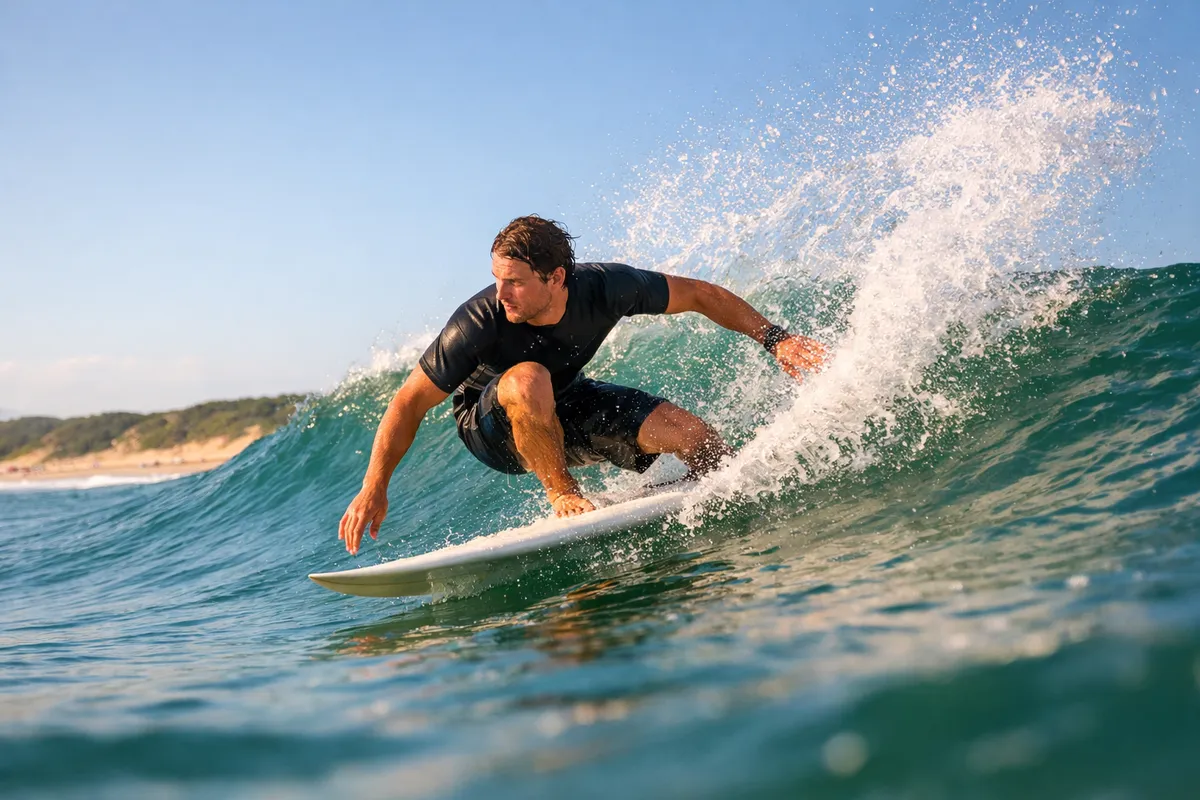
There's a point in every surfer's progression where the easy gains stop. You've mastered the pop-up. You catch whitewater every time. You can paddle out through the break. You've even caught a few green waves. But now progress has slowed to a crawl. Sessions feel repetitive. The next level — trimming along the face, generating speed, turning — seems impossibly far away.
This is the beginner-to-intermediate plateau, and it's where the majority of surfers get stuck. Not because the skills are impossibly hard, but because the approach that got you this far stops working. Here's what changes.
The mindset shift
As a beginner, you learned by repetition: paddle, pop up, ride whitewater, repeat. The feedback loop was immediate — you either stood up or you didn't. The goal was simple: don't fall.
Intermediate surfing is different. The goal shifts from "stand up" to "use the wave's energy." You're no longer just riding the whitewater to shore. You're reading the wave, choosing a direction, generating speed, and making decisions in real time.
This requires a different kind of learning: deliberate wave selection, intentional positioning, and video feedback.
Skill 1: Wave selection
Beginners take whatever the ocean gives them. Intermediates choose their waves.
What to look for:
- Waves that peel (break progressively along their length) rather than close out (break all at once). A peeling wave gives you a face to ride along.
- Waves with a clear shoulder. The "shoulder" is the unbroken section ahead of where the wave is breaking. Your job is to ride toward it.
- Smaller, cleaner waves over bigger, messy ones. A chest-high peeling wave teaches you more than a head-high closeout.
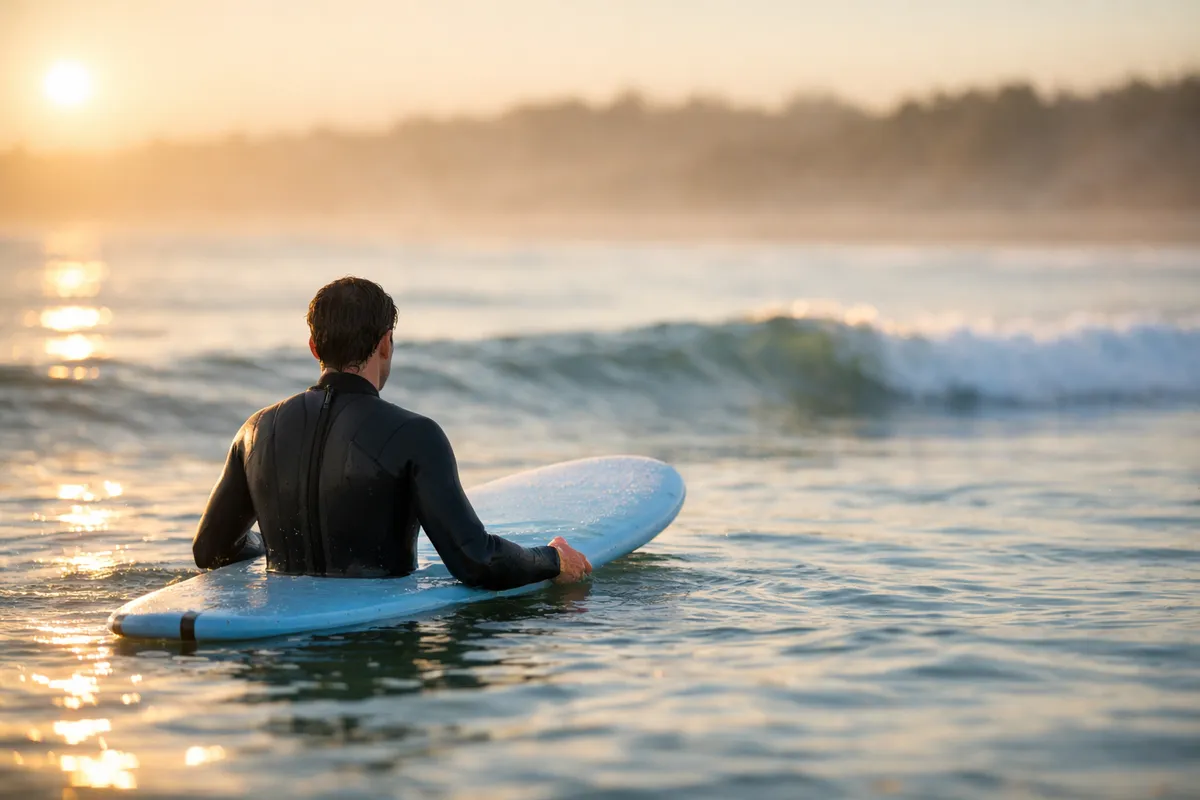
Sit in the lineup and let waves pass. Watch where they break, which direction they peel, and how fast they move. Patience in wave selection is the single biggest upgrade you can make at this stage.
Skill 2: Angling the takeoff
Beginners take off straight toward the beach. Intermediates angle their takeoff in the direction the wave is peeling.
How to do it:
- As you paddle for the wave, look along the face in the direction it's peeling (left or right).
- Angle your board slightly in that direction as you paddle — maybe 15–20 degrees off straight.
- When you pop up, your board is already pointed along the wave face, not toward the beach.
This one adjustment changes everything. Instead of riding straight to shore and losing the wave's power, you're traveling along the face where the energy is. You go further, faster, and have more time to practice everything else.
Skill 3: Generating speed
On a green wave, speed comes from the wave's energy — but only if you know how to access it.
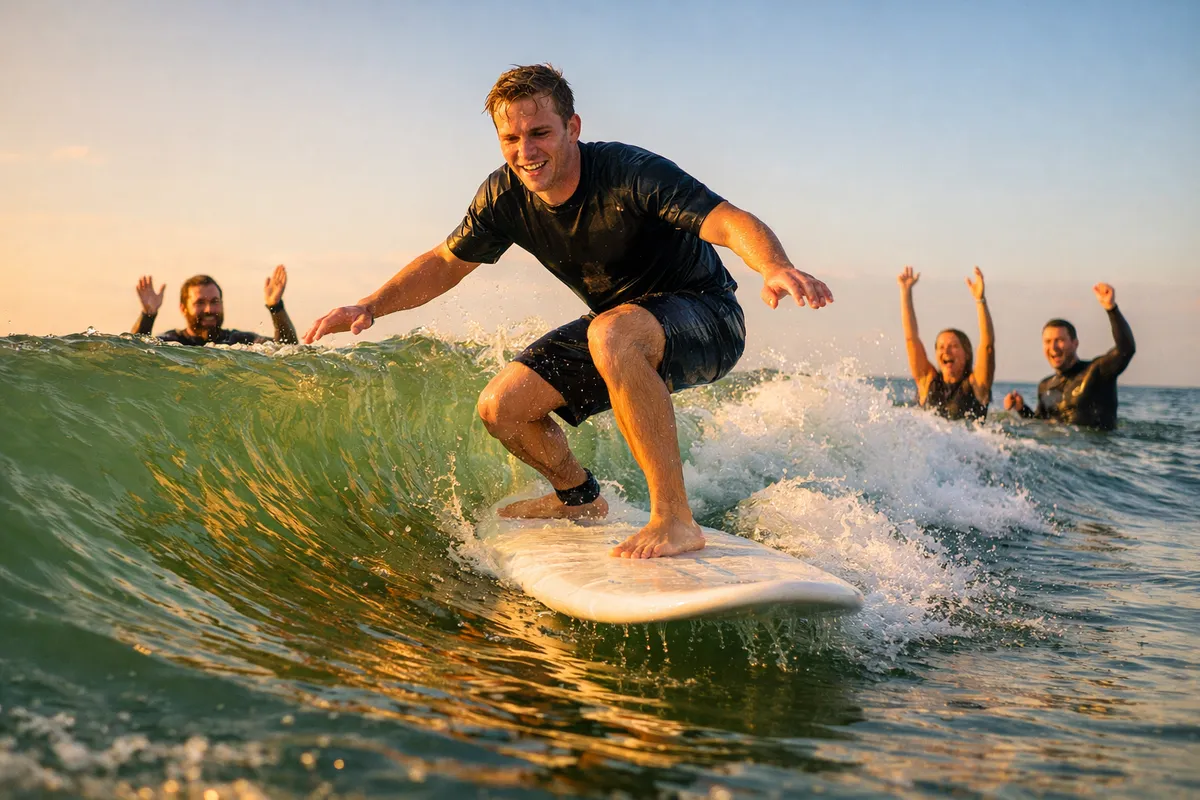
- Stay in the pocket. The "pocket" is the steep section of the wave just ahead of where it's breaking. This is where the most energy is. Too far ahead on the shoulder and the wave flattens. Too far behind and you're in the whitewater.
- Pump. Subtle up-and-down weight shifts — pressing down the face and lifting on the rise — generate speed on flat sections. Think of it like a skateboard pump on a half-pipe.
- Compress and extend. Low stance on the bottom of the wave (compress), tall stance on the top (extend). This weight transfer uses gravity to accelerate.
Skill 4: The bottom turn
The bottom turn is the most important maneuver in surfing. It's the foundation for everything — top turns, cutbacks, and eventually barrels and aerials. And it's the first real "turn" you'll learn.
After dropping down the wave face:
- Look where you want to go — up and along the wave face.
- Lean into your rail (the edge of the board). Front-side (facing the wave), this means pressing your toes and leaning your chest toward the wave. Back-side (back to the wave), it means pressing your heels and opening your shoulders.
- Let the board carve back up the face. The turn should feel like a smooth arc, not a sharp pivot.
Practice bottom turns on every wave. Even a gentle turn at the bottom of a small wave builds the muscle memory. Over time, the turn becomes deeper, faster, and more powerful.
Skill 5: The cutback
A cutback brings you back toward the breaking part of the wave when you've gone too far ahead on the shoulder. It's the first "flow" maneuver — it connects sections and keeps you in the pocket.
Basic cutback:
- Ride along the face until you're ahead of the pocket (the shoulder is flattening).
- Look back toward the whitewater.
- Shift your weight to your heels (front-side) or toes (back-side) to carve back toward the breaking section.
- Reconnect with the pocket and continue riding.
The cutback won't feel smooth for a long time. That's normal. Start with wide, sweeping arcs and let them tighten as your balance improves.
The progression toolkit
Video analysis
If there's one tool that accelerates intermediate progression, it's video. Have someone film you from the beach (or use a tripod/action cam). Watching yourself surf reveals every habit you can't feel — back foot too far forward, arms flailing, eyes looking down.
Watch the video, identify one thing to fix, and focus on that one thing for the next three sessions. Repeat.
Surf different conditions
Beginners should surf the same easy wave repeatedly. Intermediates need variety. Surf on different tides, different swell directions, different-sized days. Each new condition forces adaptation, which builds skill faster than repetition in comfortable conditions.
Upgrade your board (carefully)
If you've been on a 9-foot foamie for months and you're consistently catching green waves, it may be time to step down — but not to a shortboard. Move to a 7'6"–8' funboard or mini-mal. You'll lose some stability but gain maneuverability. The board should challenge you slightly, not completely reset your ability.
Read our softboard vs hardboard guide for when to make the switch.
Take an intermediate lesson
Most surf schools offer intermediate coaching — focused on wave selection, positioning, and turning. A single session with a good coach can identify the specific thing holding you back and give you a clear path forward.
Common plateaus and fixes
| Plateau | Likely cause |
|---|---|
| Can catch green waves but can't ride along the face | Not angling the takeoff. Practice the 15-degree paddle angle. |
| Rides die quickly (lose speed) | Not in the pocket. Stay closer to the breaking section. |
| Can't turn | Looking down at the board instead of where you want to go. Eyes lead the turn. |
| Everything feels stiff | Stance too rigid. Bend your knees more, loosen your hips, keep your arms relaxed. |
How long does the transition take?
Typically 6–18 months of regular surfing (2–3 sessions per week). Some people cross it faster with coaching and video. Some take longer because they surf infrequently or in conditions that don't challenge them.
The key: surf regularly, surf intentionally, and get feedback. Progress isn't linear — you'll have breakthrough sessions and regression sessions. That's normal. Keep showing up.