Every surf instructor has a mental list of mistakes they see every single day. The same errors, the same causes, the same corrections. The fact that everyone makes them doesn't make them less frustrating — but it does mean the fixes are well-known and well-tested.
Here are the 10 most common beginner mistakes and exactly how to fix each one.
1. Board too small
The mistake: Starting on a shortboard (under 7 feet) because it looks cool or because a shop recommended the wrong size.
Why it's wrong: Shortboards are designed for intermediate and advanced surfers. They're narrow, unstable, and have low volume — which means they don't float well enough for a beginner's weight and paddling power. You'll spend more time falling off than learning.
The fix: Start on a 8–9 foot soft-top foam board. More volume = more stability = more waves caught = faster learning. There's no shortcut through this stage. Read our board selection guide.
2. Hands too far forward on the pop-up
The mistake: Placing your hands near your shoulders (like a standard push-up) instead of at chest level.
Why it's wrong: Hands at shoulder level push you up but don't give you room to bring your feet under you. You end up on your knees instead of your feet.
The fix: Hands at lower chest / rib level, slightly wider than shoulder width. This creates space for your feet to swing through to your standing position.
3. The knee pop-up
The mistake: Going to your knees first, then standing up from a kneeling position.
Why it's wrong: It's slower, less stable, and creates a bad habit that's very hard to unlearn later. The kneeling position doesn't translate to real surfing — you need to go straight from prone to standing.
The fix: One explosive motion: push up → swing feet under → land in a standing surf stance. Practice on the beach 20 times before entering the water. If you can't do the motion on sand, you can't do it on water.
4. Looking down at the board
The mistake: Staring at your feet or the board during the pop-up and while riding.
Why it's wrong: Your body follows your eyes. Look down and your weight shifts forward, your stance becomes rigid, and you lose awareness of the wave. It's also the #1 cause of nose-diving ("pearling").
The fix: Look where you want to go — forward along the wave, or at the beach if you're in whitewater. Eyes up from the moment you start the pop-up. This single correction fixes multiple problems simultaneously.
5. Surfing straight to shore
The mistake: Catching a wave and riding it directly toward the beach, perpendicular to the wave face.
Why it's wrong: You're riding the weakest part of the wave's energy. The ride is short, slow, and ends in the shallows.
The fix: Angle your takeoff (see beginner to intermediate guide). As you paddle for the wave, look along the face in the direction it's peeling and angle your board 15–20 degrees that way. You'll ride along the wave instead of straight in.
6. Not paddling hard enough
The mistake: Lazy paddling when trying to catch a wave. Gentle strokes, low effort, hoping the wave will do the work.
Why it's wrong: The wave can only pick you up if you're already moving close to its speed. Half-effort paddling means the wave passes under you.
The fix: When you commit to a wave, paddle like you mean it. Deep, powerful strokes — hand enters the water ahead of your head, pulls all the way to your hip. 6–8 hard strokes, not 15 casual ones.
7. Stiff, upright stance
The mistake: Standing tall and rigid once you're on the wave. Straight legs, locked knees, arms at your sides.
Why it's wrong: A stiff stance can't absorb the wave's movement. Every bump and shift throws you off balance.
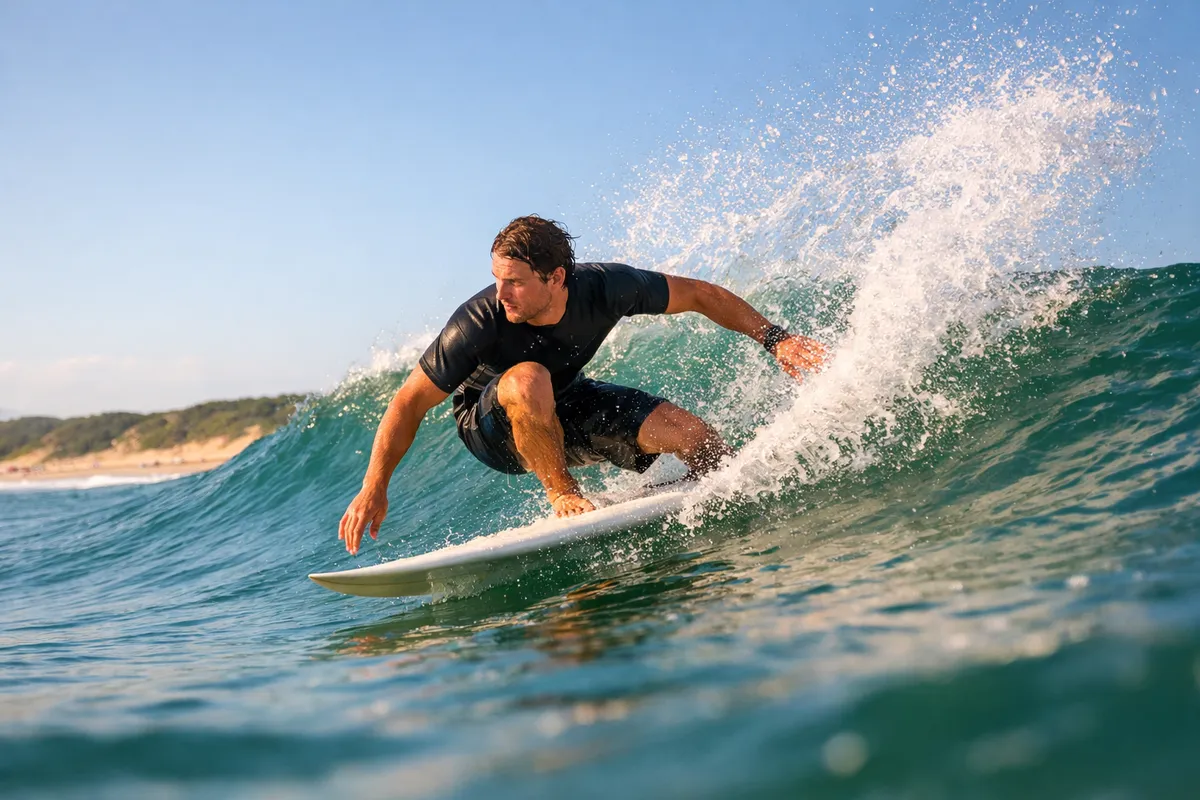
The fix: Bend your knees. Low stance, weight centered, arms out for balance (like a slight squat). Your knees are your shock absorbers. The lower and looser your stance, the more stable you are.
8. Wrong foot forward
The mistake: Surfing with the wrong foot forward because you never figured out which foot is your lead foot.
Why it's wrong: Your natural stance (regular = left foot forward, goofy = right foot forward) is determined by your body's proprioception. Surfing with the wrong foot forward feels awkward and limits your control.
The fix: Stand naturally and have someone gently push you from behind. Whichever foot you step forward with to catch your balance is your front foot. Or: which foot would you put forward on a skateboard or snowboard? Same foot goes forward on the surfboard.
9. Paddling out through the impact zone
The mistake: Paddling straight out through the area where waves are breaking most powerfully.
Why it's wrong: You get hammered by every wave, lose energy, and barely make progress.
The fix: Look for a channel (deeper, calmer water between breaking sections). Paddle out through the channel. Time your paddle-out for the lull between sets. Read our paddle-out guide.
10. Not wearing a rash guard
The mistake: Surfing in just a swimsuit in warm water without a rash guard or wetsuit.
Why it's wrong: The repeated pushing-up motion on the board's surface rubs your chest, nipples, and inner arms raw within 30 minutes. Board rash is extremely common and extremely preventable.
The fix: Wear a rash guard — a thin lycra shirt designed for water. If you're in a wetsuit, the suit handles it. In warm water, a rash guard is essential. $20–40 investment that saves you days of pain.
The meta-fix
Most of these mistakes share a root cause: lack of feedback. You can't see yourself surfing. You don't know your hands are in the wrong position or your eyes are looking down until someone tells you.
The two best feedback tools:
- An instructor in the water. Real-time correction is the fastest way to fix technique.
- Video. Have someone film you. Watch it. The gap between what you think you look like and what you actually look like is humbling and educational.